Water Features Benbrook TX | Outdoor Fountains & Koi Ponds
Texas Stone Craft builds hand-carved GFRC water features in Benbrook TX for hillside and lake-area lots. Outdoor fountains run $3,500-$9,000, pondless cascades $5,000-$12,000, pool waterfalls $8,000-$22,000, grottos $15,000-$40,000+ and koi ponds $25,000-$40,000+. Most builds take 7-10 days on site once the City of Benbrook permit is in hand.
| Service | Hand-carved GFRC outdoor fountains, koi ponds, hillside cascades, pool waterfalls and grottos for Benbrook homes |
|---|---|
| Service area | Benbrook hillside lots, the lakeside streets near Benbrook Lake and the flatter in-town lots across southwest Tarrant County |
| Typical price range | $3,500-$9,000 outdoor fountain, $5,000-$12,000 pondless cascade, $8,000-$22,000 pool waterfall, $15,000-$40,000+ grotto, $25,000-$40,000+ koi pond |
| Typical timeline | 7-10 days on site for most builds, after the permit clears |
| Materials | Poured footing with steel rebar, then a GFRC carving mix stacked on the steel by hand and carved on site. Rated up to 4,000 PSI |
| Permits | Benbrook's Building Permits and Inspections Department requires a permit for any new structure; residential review runs 10 business days. Electrical and plumbing contractors register their state license with the city. |
| Lake lots | The Corps of Engineers owns the land under and around Benbrook Lake and holds flowage easements on some private lots. Building, fill or digging inside an easement needs the Corps' written approval first. |
| Warranty | 5-year workmanship warranty |
| Why GFRC instead of boulders | Carved to follow the slope, far lighter than trucked-in rock on a hillside, no mortar joints to open, and 40-60% less cost than natural stone |
Water Features in Benbrook TX for Hillside and Lake-Area Yards
We build water features in Benbrook TX for people who have lived with a sloped yard for years and want to make use of it. A Benbrook backyard often drops several feet from the patio to the back fence, and plenty of owners have spent that time mowing a hill they cannot sit on. Moving water is one of the few things that looks better on a slope than on flat ground. A cascade can step down the grade, a koi pond can sit on a carved terrace, and an outdoor fountain can anchor a level patio cut into the hill.
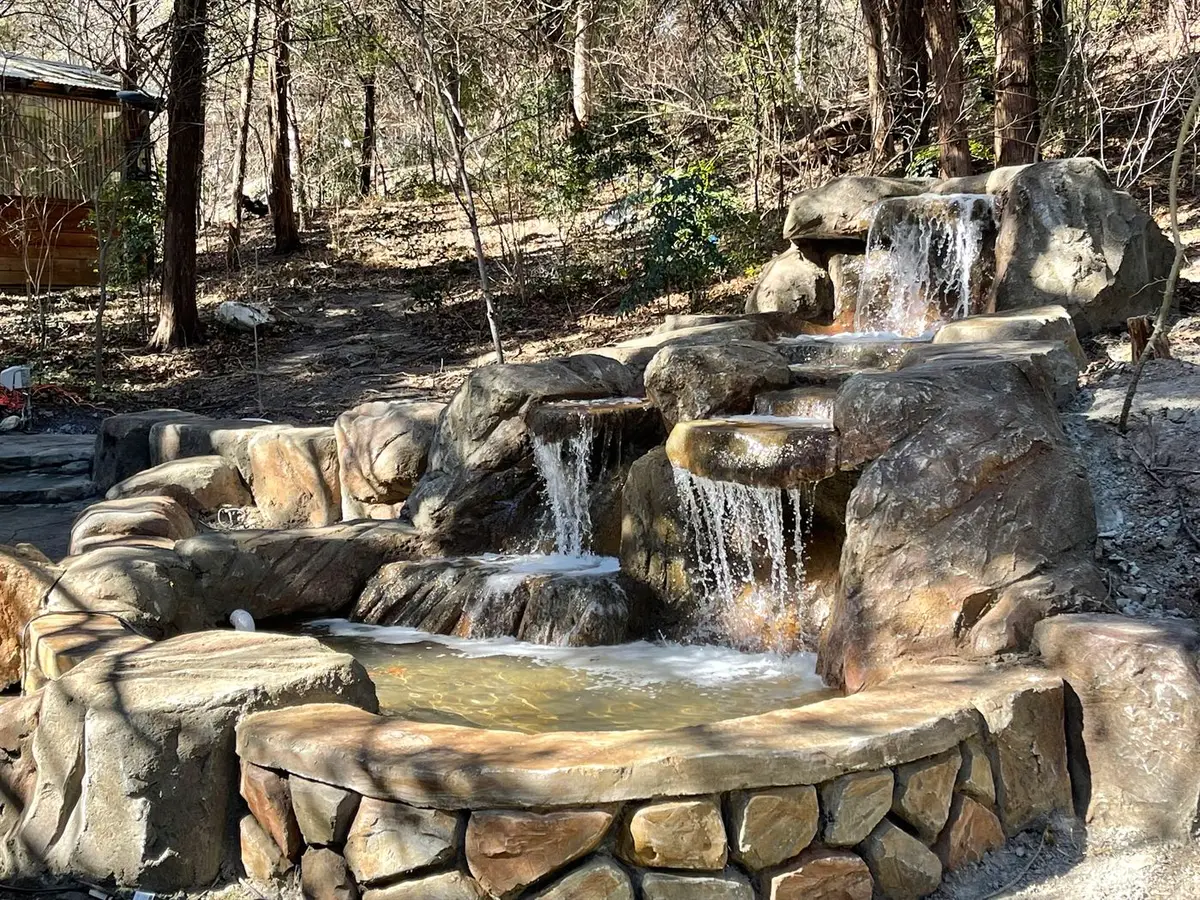
Benbrook sits in southwest Tarrant County, about ten miles southwest of downtown Fort Worth, beside Benbrook Lake. Much of the town is hilly, and the grade shapes every water feature we plan in town: where the footing goes, which way the overflow runs, and how storm water gets around the pond.
Every Benbrook feature is carved by hand in your yard. We pour a footing with steel rebar and leave bars standing up from it. Our carvers build a GFRC carving mix up on that steel by hand, layer over layer, and cut the rock texture into each layer before it sets. The finished face is one steel-tied piece, with no mortar joints to open. We use no molds or forms. The carving mix is rated up to 4,000 PSI, we expect 50+ years out of it, and it costs 40-60% less than hauling natural boulders up a hillside lot.
Why a Sloped Benbrook Lot Suits Falling Water
On a flat lot, we build the height a waterfall needs: a berm, a raised rock wall, a stack of carved ledges. On a Benbrook slope, the ground supplies most of it. A yard that falls four feet from the patio edge to the fence can carry a cascade with five or six short drops and never look piled up.
We lay these out from the bottom. The catch basin or buried reservoir goes at the low end, where water would collect anyway. The drops climb the grade toward the house, and a return line runs back up to the top spout. You hear the water from the patio, and you see the whole run from the kitchen window instead of the back of a rock pile.
Steeper yards take taller falls. A grade that drops eight or ten feet over a short distance can hold a single falls taller than a person, or a set of terraces with a pool of water on each one. Where the slope is steep enough that the hill itself needs holding, we pair the feature with carved retaining walls in Benbrook and plan both at once.
Outdoor Fountain Benbrook Homeowners Can Fit on a Slope
Not every Benbrook yard has room for a pond. An outdoor fountain is the answer for a front walk, a courtyard, a side yard or a small patio. It also suits a hillside front yard, where a fountain on a level pad gives the entry a focal point.
Carved Bowl and Basin Fountains
A carved bowl on a pedestal, or a low round basin with a bubbler in the middle, fits a patio of almost any size. We carve the rim thick enough to sit on, tint it to match the house, and set a light under the water for the evenings. Most come in between $3,500 and $9,000.
Wall Fountains Set Into a Terrace Wall
Hillside lots tend to end up with walls. A wall that holds up a terrace is a good place to hang a fountain: water spills from a carved spout into a basin at the foot of the wall. The pump and lines run inside the wall, so nothing shows. We keep the fountain plumbing apart from the drain behind the wall.
Fountains for Entries and Front Walks
On a sloped front yard, we cut a level pad, pour the footing, and set the fountain where it reads from the street and from the front door. A single spout into a raised basin is enough. The sound carries, and it covers some road noise on the busier streets.
Pond Builders Near Benbrook: Koi Ponds on Clay, Fill and Rock
Owners looking for pond builders near Benbrook want fish and somewhere to sit beside them. Benbrook ground gives a pond three things to deal with, often on the same lot.
Thin Clay Over Limestone
On some Benbrook lots, a thin layer of clay covers limestone a foot or two down. Koi need a deep zone of four to five feet to stay cool in August, so a full-depth dig there means cutting rock. We probe the spot first. Where rock is shallow, we cut it with a rock saw or a breaker, or we raise the pond: dig as deep as the rock allows, then carve the walls up above grade until the water is deep enough. The raised rim doubles as a seat.
The Fill Line on an Older Graded Lot
Some older Benbrook houses sit on pads graded when the street was built. The builder cut into the hill on one side and pushed that dirt onto the low side to make a flat spot for the house. The built-up side can keep settling for years. A pond that straddles the line between cut ground and fill can crack along it or tip toward the low side. We find the fill line during the site walk and keep the pond on the cut side when the yard allows. When the pond has to sit on fill, we dig the footing through the fill to native soil or rock.
Building the Basin
Under the carved rock, every koi pond gets a reinforced concrete shell over a heavy liner, a bottom drain at the deepest point, mechanical and biological filters, a UV clarifier and an auto-fill valve. The filters are sized for the fish you expect to have in five years, since a healthy pond breeds. The shell, the drain and the filter train account for most of the cost, and they put a complete koi pond in the $25,000 to $40,000+ range.
Where the Equipment Pad Goes
We place the equipment pad where you can stand at it, on level ground near a path, with no climbing across the rocks to reach a pump. A filter you have to climb over rocks to reach stops getting cleaned, so the pad location goes on the first drawing.
Storm Water and the Draws Between Benbrook Houses
Benbrook hills funnel storm water into draws, the low strips of yard between houses where runoff collects and runs downhill. A pond dropped into one with its rim at grade fills with muddy runoff every hard rain. That water carries silt, leaves and lawn fertilizer, and fish do badly in it.
We read the draws before choosing a spot. We set the pond rim a few inches above the surrounding grade, and where a draw runs toward the feature, we cut a shallow swale uphill to carry storm water around it. The pond's own overflow goes to a point the lot already drains toward, so it never puts water against the house or the neighbor's fence.
West-facing slopes add one more factor. They catch the hardest afternoon sun in the summer, which pushes evaporation up and fades color. The auto-fill handles the water. For color, we mix the base tint into the carving coat itself, add stain on top, and finish with a UV-stable sealer.
Lots Near Benbrook Lake and the Corps of Engineers Line
Benbrook Lake is a U.S. Army Corps of Engineers reservoir. The government owns the lake and the public land around it, marked off by a boundary line with concrete monuments. Past that line, some private lots carry a Corps flowage easement: the Corps bought the right to let floodwater cover that ground now and then. The deed describes the easement, and the Corps leaves it to the owner to find its elevation on the lot.
That easement changes what we can build. The Corps bans houses on it, and any other structure, fill or excavation needs its written approval first. A carved pond is a structure and a dig at the same time. So on a lake-area lot we read the deed and survey before we draw anything, and set the feature, its footing, its equipment pad and its overflow above the easement elevation when the yard allows. If the best view sits inside the easement, we turn the feature so you face the lake from the patio, or we take the plan to the Benbrook Lake office before anyone digs.
Some owners ask whether we can run a falls off lake water. We do not. Every feature we build runs in a closed loop on house water. Lake water brings silt and algae that clog a pump and stain the carved rock.
Water Feature Installation Benbrook: Permits and Approvals
Benbrook's Building Permits and Inspections Department, part of Community Development, handles residential permits. The city's FAQ says a permit is required for any new structure, addition or remodel, and that residential plan review takes 10 business days. It also says plumbers and electrical contractors hold state licenses and must register them with the city. A water feature brings in all three: the carved structure, the pump circuit and the plumbing. We confirm with the department what your feature needs, prepare the drawings and file them. The build date is set once the permit is approved.
If the feature sits beside a terrace wall, the wall has its own rule. Benbrook exempts retaining walls under 4 feet tall from a permit, so a taller wall holding the fountain's terrace goes on the same application.
If your street has an HOA, we ask for its rules during the first visit. An association may want a site plan, a color sample and a lighting plan before anything is built. We draw to those rules and put that package together with the permit drawings.
More Water Features for Benbrook Yards
A hillside lot has room for other kinds of moving water too.
Pondless Hillside Cascades
A pondless cascade runs down carved tiers into a gravel bed over a buried reservoir. There is no open water, so it works for homes where grandkids visit. On a slope, it is the simplest way to fill the grade with moving water. Plan on $5,000 to $12,000. Longer runs and extra tiers push it toward the top of that range.
Rock Edges and Falls on an Existing Pool
Plenty of Benbrook pools have a plain tile edge. We carve rock along the coping or build a falls on the bond beam, and on a sloped lot the falls can sit against the uphill side of the pool so the grade does part of the work. Most of these run $8,000 to $22,000.
Grottos
A grotto is a carved cave at the pool's edge with water falling across the opening and a bench behind it. On a hillside pool, we can tuck the grotto into the uphill bank so it reads as part of the slope. Grottos run $15,000 to $40,000 or more. See our pool grotto page for the details.
Benbrook Water Feature Prices
Prices include the permit, excavation, the footing, steel, carving, plumbing, the electrical tie-in, lighting and cleanup.
| Feature | Typical range |
|---|---|
| Outdoor fountain | $3,500 - $9,000 |
| Pondless hillside cascade | $5,000 - $12,000 |
| Waterfall on an existing pool | $8,000 - $22,000 |
| Grotto | $15,000 - $40,000+ |
| Koi pond system | $25,000 - $40,000+ |
What Moves a Benbrook Quote
Every foot we cut into limestone for a basin, a reservoir or a trench adds time. On a hillside, the equipment pad often sits up by the house while the feature sits down the slope, and you pay for every foot of pipe and conduit between them. A footing dug through fill to native ground goes deeper than one on cut ground. Smaller items add up too: a full breaker box that needs a sub-panel, wiring into existing pool automation, and access when a crew has to carry material down a steep side yard.
Typical Benbrook Builds
Each of these is a typical build at a typical cost, and none describes a particular client.
Typical Stepped Cascade Down a Back Slope
A pondless cascade with six short drops down a back yard that falls about four feet to the fence. A buried reservoir at the low end, a swale above it to carry storm water around, and lights at three of the drops. Typical total around $11,000, 7-10 days on site.
Typical Raised Koi Pond on Shallow Rock
A koi pond dug about two feet down to rock, with carved walls rising another two and a half feet to give the fish their depth. A seat-height rim on the patio side, a bottom drain, filters, UV and auto-fill, with the equipment pad on level ground by the side gate. Typical total around $32,000, 7-10 days on site.
Typical Wall Fountain in a Terrace Wall
A carved spout set into the face of a terrace wall, spilling into a raised basin at its foot, with a light in the basin. Typical total around $6,500 for the fountain, 7-10 days on site.
How a Benbrook Water Feature Job Runs
- Site walk. We measure the grade, probe for rock, find the fill line on graded lots, trace the draws and check the survey on lake-area lots.
- Drawing and quote. We send a plan view, a side elevation and a fixed price built on what we found on the walk.
- Permit and HOA. We file the drawings with the city, plus the HOA package if your street has one.
- Footing and steel. The footing goes to native ground or rock, and the rebar stands up from it.
- Carving. The crew stacks the carving mix on the steel, carves it while it is workable, then stains and seals it.
- Startup. We connect and test the pump, plumbing and lights, then walk you through the upkeep.
Upkeep and Warranty
We build Benbrook features to need little attention. The auto-fill covers evaporation. Skimmer baskets get emptied every week or two, more often when leaves come down in the fall. Filters get rinsed a few times a season, and the pump gets checked once a year. Plan on resealing the carved GFRC every 3-5 years. Natural rock in the same spot would want sealing every year.
On the few hard freeze nights each winter, the pump controller can keep water moving so the lines do not freeze. Every feature carries our 5-year workmanship warranty.
What a Water Feature Does for a Hillside Yard
A sloped yard is often the part of the lot nobody uses. A cascade down the grade, a koi pond on a carved terrace, or a fountain on a level patio gives you a place to sit on it. The sound of water reaches the patio and the open windows. We tint the carved rock face to the color of the house so it reads as part of the property.
Plan Your Benbrook Water Feature
Every Benbrook project starts with a free site walk. We walk the slope, probe for rock, find any fill line, and bring finish samples. Then you get a drawing and a fixed quote. Read how we carve rock faces in our carved concrete waterfalls guide, or see a finished build in our hand-carved GFRC waterfall case study.
Explore Other DFW Water Feature Areas
We design and install water features throughout the Dallas-Fort Worth metroplex. Explore our city-specific services:
- Water Features Fort Worth — Fort Worth water feature design and installation
- Water Features Aledo — Bedrock-anchored water features for Parker County rock lots
- Water Features Granbury — Lake-lot falls and koi ponds for Granbury
- Water Features Crowley — Water features for flat clay lots
- Water Features Burleson — Pool remodel waterfalls for Burleson and Johnson County lots
- Water Features Azle — Terraced falls and koi ponds for Eagle Mountain Lake slopes
- Water Features Mansfield — Family water features for newer Mansfield subdivisions
- Water Features Arlington — Pool waterfalls and family-safe water features
- Water Features Keller — Creekside water features for Keller's larger lots
- Water Features Haslet — Acreage water features for Alliance corridor properties
- Water Features Northlake — New-community water features for Harvest and Pecan Square
- Water Features Westlake — Acre-lot estate water features for Vaquero and Glenwyck Farms
- Water Features Southlake — Architectural water features for Southlake estates
- Water Features Colleyville — Private water features for established Colleyville estates
- Water Features Grapevine — Lakeside water features near Grapevine Lake
- Water Features Flower Mound — Terraced water features for Flower Mound slopes
- Water Features Rockwall — Waterfront water features near Lake Ray Hubbard
- Water Features Dallas — Custom water features for Dallas homes
- Water Features Plano — HOA-approved ponds and waterfalls for Plano estates
- Water Features Frisco — Modern LED-lit features for master-planned communities
- Water Features Allen — Contemporary water features for Allen's new-build communities
- Water Features McKinney — Naturalistic ponds, streams, and boulder waterfalls
- Water Features Prosper — Estate-scale water features for luxury properties
More Services for Benbrook Homeowners
- Retaining Walls in Benbrook — Hillside slope walls and terracing for Benbrook lots
- Retaining Walls — Carved concrete walls across DFW
- Pool Grottos — Hand-carved grottos with waterfalls and slides
- Outdoor Kitchens — Custom GFRC outdoor living spaces
- All Water Features — Full service overview
Get a written estimate
Tell us about your project and we will set up a time to look at the site and price it. Request an estimate or call (469) 290-1675.
Last updated: