Water Features Aledo TX | Bedrock-Anchored Waterfalls
Texas Stone Craft builds hand-carved GFRC water features in Aledo: pool waterfalls, pondless cascades, koi ponds and grottos. Pondless builds run $5,000-$11,000, pool waterfalls $8,500-$19,000 and grottos $15,000-$40,000+. Most take 7-10 days on site. Aledo lots sit on shallow limestone, so we core drill and pin every feature to bedrock.
| Service | Hand-carved GFRC water features, pool waterfalls, pondless cascades, koi ponds and grottos |
|---|---|
| Service area | Aledo, Walsh Ranch, Morningstar, Parks of Aledo, Bailey Ranch and Parker County acreage along FM 1187 |
| Typical price range | $3,500-$8,500 courtyard fountain, $8,500-$19,000 pool waterfall, $25,000-$40,000+ koi pond, $15,000-$40,000+ grotto |
| Typical timeline | 7-10 days on site for a pondless cascade, a pool waterfall or a grotto |
| Materials | Glass Fiber Reinforced Concrete rated up to 4,000 PSI, hand-carved on site |
| Permits | Aledo Development Services, Fort Worth Development Services for Walsh Ranch, or Parker County septic setbacks. We file in the right one. |
| Foundation | Core-drilled 6-8 inch holes with epoxy-grouted anchor bolts pinned to limestone at 12-24 inches |
| Warranty | 5-year workmanship warranty |
| Why GFRC instead of natural stone | A thin carved shell, far lighter than solid stone, so it needs fewer anchor points in rock, and it costs 40-60% less |
Water Features Built on Aledo's Limestone Shelf
Water features in Aledo get built on rock. Sandy loam runs thin out here on the Parker County line, and under most lots you hit limestone somewhere between 12 and 24 inches down. Trench-and-pour footings reach refusal before they reach design depth. We core drill into the shelf and pin the feature to it instead. An Aledo waterfall ends up sitting more solidly than the same build on Dallas clay.
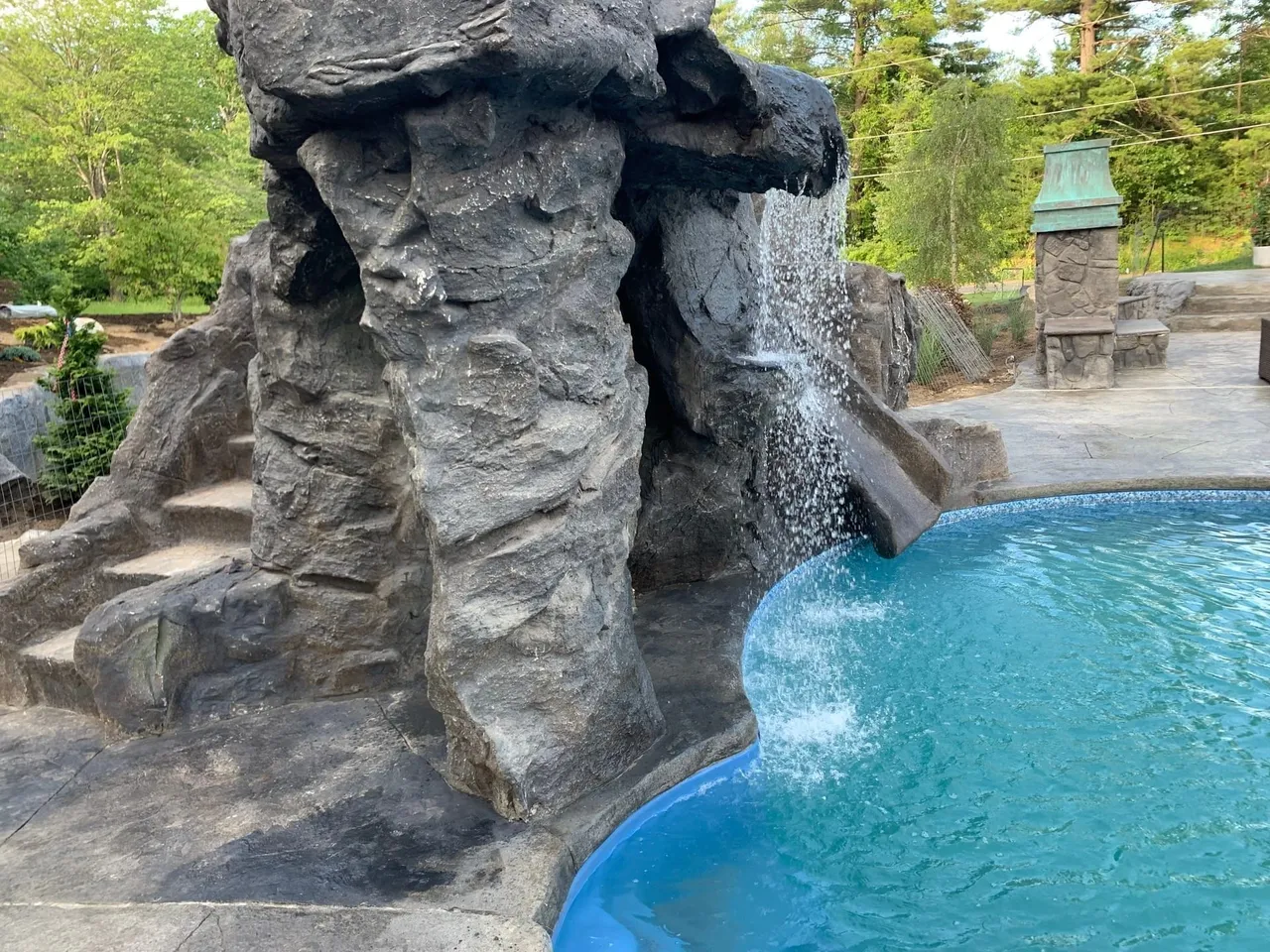
We have carved water features from one end of Aledo to the other, from pool retrofits in Walsh Ranch to koi ponds on ten acres off FM 1187. Water feature installation in Aledo starts with finding that depth to rock, because it decides how many core holes the job needs. The rock is GFRC and every face of it gets carved by hand on your property, keyed to whatever stone is already on the house. It weighs a quarter of what real stone weighs, which on a bedrock lot is the whole argument: fewer anchors, smaller holes, less money.
Water features in Aledo TX serve two types of buyers. Families in Walsh Ranch and Morningstar want pool upgrades that turn a builder-grade backyard into something worth coming home to. Acreage owners along FM 1187 and the I-20 corridor have room for koi ponds, multi-tier cascades, and features set 100 feet from the house among the live oaks.
Why GFRC Anchors to Aledo's Shallow Bedrock
Parker County's geology under Aledo is Western Cross Timbers sandy loam over limestone and sandstone. The topsoil drains fast, holds minimal water, and sits 12-24 inches above solid rock. That thin soil layer means conventional footings cannot reach the depth that most foundation engineers call for. You hit limestone before you hit the design depth.
We solve this by core drilling 6-8 inch holes into the bedrock and setting epoxy-grouted steel anchor bolts. The water feature pad ties directly to rock. Zero seasonal movement. Zero settling. Zero frost heave. In most of DFW, we fight clay expansion. In Aledo, the foundation problem is access to the rock, not stability once you get there.
GFRC makes this process cheaper and faster. Because a GFRC feature is a thin shell rather than solid rock, it needs fewer anchor points and smaller core holes. A pool waterfall that would require 12-15 anchor bolts in natural stone needs 6-8 in GFRC. Each core-drilled hole costs $150-$300 depending on depth and diameter. The savings add up to $1,000-$2,000 on a typical Aledo installation.
GFRC is dense and takes on far less water than stacked rock, and we seal every carved face. Sandy loam drains fast and dries fast, so surface conditions swing between wet and dry more rapidly than on clay sites. Natural stone with porous mortar joints wicks that moisture in and out. Over years, the expansion-contraction cycle cracks mortar and loosens stacked rock. GFRC has no mortar joints for that cycle to work on. Rated up to 4,000 PSI, with a 50-year service life, the carving will still be there after the roof has been replaced twice. Every crack and vein gets cut by hand while the GFRC is still green, matched to the same limestone sitting 18 inches under your grass.
Then there is the invoice. GFRC comes in 40-60% under the equivalent natural stone build. In Morningstar that gap is what lets a homeowner run lighting and audio on the same budget instead of picking one.
Water Feature Styles for Aledo's Ranch and Subdivision Properties
Rock-Anchored Pool Waterfalls
Most Walsh Ranch and Morningstar backyards came with a rectangular builder pool and not much else. We tie a carved formation into the bond beam with stainless anchors and bring the rock up 3 to 8 feet above the waterline. Flow lands between 30 and 80 GPM. Push it higher and a south wind will empty half of it onto the deck. LED strips go behind the sheet so the thing still reads after dark. Because the pad pins to limestone instead of floating on loam, the waterfall does not drift out of plumb the way pool features do east of here.
Pondless Cascades on Bedrock
A pondless build hides the water. The reservoir is gravel under grade, the pump recirculates, and nothing stands open. No fence, no mosquitoes, nothing a four-year-old can fall into. Aledo homeowners put these in the front yard more than anywhere else we work, often right against an outcrop that was already sitting there. Out on acreage we set one in a clearing between live oaks so it becomes somewhere to walk to. The reservoir bears on rock, so it holds its level.
Koi Pond Contractor in Aledo, Working Through the Shelf
Digging a pond in Aledo means getting through rock. Fish need four feet of water to survive a Parker County August, and on a lot where limestone starts at 18 inches that is thirty inches of breaker work. The payoff is the ledge. Once the shelf is open, we lay a heavy liner against the rock, build a reinforced concrete shell over it, and carve the GFRC rim to meet the cut face so the two read as one formation. We won't drop a bare rubber liner in the hole and stack rock around it. The shell, the bottom drain and the filtration vault cost more, and they are why an Aledo koi pond runs $25,000-$40,000+. Filtration runs mechanical and biological out of a buried vault near the equipment pad. An auto-fill valve replaces what the wind takes. Ask any pond builders near Aledo how they plan to get through the limestone; that breaker work sets both the price and the schedule.
Swim-Through Grottos
A grotto puts a roof over part of the pool. You swim under the falls into a pocket with dry bench seating carved into the back wall. Pricing starts at $19,000 for the plain swim-through and reaches $36,000 once color LED, speakers and a second seating shelf go in. The newer Morningstar sections have almost no mature shade, so a grotto ends up doing a pergola's job while adding to the pool instead of standing next to it.
Courtyard and Entry Fountains
Small recirculating fountains for a front courtyard, a covered patio, or the side yard nobody uses. They run $3,500 to $8,500 and go in over 7-10 days. The footing is shallow enough that on most Aledo lots we hit rock at exactly the right depth and have it pinned inside an hour.
Where We Build in Aledo — Walsh Ranch to FM 1187 Acreage
Walsh Ranch
Aledo's largest master-planned community. Walsh Ranch technically sits inside Fort Worth city limits despite the Aledo mailing address and Aledo ISD enrollment. Standard subdivision lots with pool-ready backyards. Soil is the same Parker County sandy loam with limestone underneath, though some sections have deeper topsoil from the development grading. Pool waterfall retrofits and pondless cascades are the most common requests.
Morningstar
Newer master-planned community south of I-20. Many backyards were delivered with a pool and bare landscaping. Water features here are often part of a first-phase backyard buildout within the first year of ownership. The HOA requires architectural review, and we prepare the full submission package.
Parks of Aledo
Within Aledo city limits. Mid-range homes with standard lots. Pool waterfalls and pondless front-yard cascades fit the lot sizes here. Permits go through Aledo Development Services, which processes residential applications faster than Fort Worth.
Bailey Ranch
Established neighborhood with a mix of home ages and lot sizes. Some properties here have mature trees that create shaded areas suited for naturalistic water features, koi ponds, and stream systems that wind through existing landscaping.
FM 1187 and I-20 Acreage
Rural parcels along FM 1187, Bankhead Highway, and the I-20 frontage road range from 2 to 20+ acres. Most run on private septic systems and wells. These properties have the space for large-scale features: koi ponds with 15-foot waterfall returns, multi-tier cascades following natural grade, and water features positioned 100+ feet from the house in a garden or pasture setting. Extended plumbing and electrical runs from the house add to the cost, but the lot gives us room to design without the constraints of a subdivision footprint.
Three Permitting Jurisdictions in One Market
Aledo is unusual in DFW because a single real estate market spans three permitting authorities. Where your lot sits determines who reviews the permit.
Aledo city lots — Parks of Aledo, Bailey Ranch, and homes within Aledo's city limits permit through Aledo Development Services. The office is small, the staff handles applications directly, and turnaround runs 1-2 weeks. Fees are low by DFW standards.
Walsh Ranch — Despite its Aledo address, Walsh Ranch is inside Fort Worth city limits. Water feature permits go through Fort Worth Development Services. Fort Worth plan review is more involved and runs 2-3 weeks. Pool modification permits require a separate application when tying a waterfall into existing pool plumbing.
Unincorporated Parker County — Acreage properties between the subdivisions often sit outside any city limits. Parker County does not issue residential building permits for hardscape structures. Septic setbacks still route through the county. We confirm setback distances from the tank and drainfield before placing any water feature on a septic lot.
We determine which jurisdiction applies to your property during the site visit and handle the full permit process through the correct office. Homeowners in Aledo should not have to figure out which government handles their permit.
Aledo Water Feature Pricing for Rock-Substrate Lots
Entry Level ($3,500-$11,000)
Courtyard fountains and small pondless cascades. Seven to ten days on site, and they fit any lot in town. A 3-4 foot pondless cascade with LED accent lighting runs $5,000-$8,000 installed. Front-yard features in Walsh Ranch and Morningstar fall in this range. Core drilling on rock lots adds $500-$1,500 to the footing cost.
Mid-Range ($8,500-$19,000)
This is where most Walsh Ranch and Morningstar jobs land. Expect 4 to 6 feet of cascade, 40 to 60 GPM, lighting, and carved texture keyed to whatever stone is on the house. The number covers permit fees in whichever jurisdiction applies, core drilling and anchors, the GFRC build, plumbing and electrical, and putting the yard back the way we found it.
Premium ($19,000-$40,000+)
Grottos, full koi ecosystems, and jobs that run more than one feature off the same equipment pad. Acreage clients pairing a pond with its own cascade end up here, and so do the grottos with lighting and audio in them. A koi pond starts at $25,000 and passes $40,000 once a long stream or a second cascade joins it. Koi ponds on rock lots require breaking through the limestone shelf, which adds $2,000-$4,000 to excavation.
What Drives Cost Up on Aledo Properties
Shallow bedrock adds core drilling and anchor bolt expense to nearly every project. The cost per anchor point runs $150-$300. Acreage lots with extended plumbing and electrical runs from the house add $1,500-$4,000. Koi pond excavation through limestone requires hydraulic breaker work rather than standard backhoe digging. Anything over 5 feet tall needs a steel armature behind the carving. Running separate zones on their own pumps means more panel capacity and more wire in the trench.
Recent Aledo Water Feature Projects
Walsh Ranch Pool Waterfall with LED Lighting
A family in Walsh Ranch wanted to upgrade their 2021-built pool from a bare concrete deck to a resort-style feature. We built a 5-foot GFRC waterfall at the deep end with carved limestone texture matching the home's veneer. The cascade runs 50 GPM with LED color-cycling strips behind the water curtain. Core-drilled anchor bolts pinned the waterfall pad to bedrock at 20 inches. A dedicated pump drives the falls, so it runs whether or not the filter is on. $13,800 all in.
FM 1187 Acreage Koi Pond and Cascade
An acreage homeowner on 5 acres wanted a koi pond as the focal point of a garden area 90 feet from the house. We broke through the limestone shelf at 16 inches to excavate a 12-by-16-foot pond to 4 feet deep, then laid a heavy liner and built a reinforced concrete shell over it. The exposed limestone ledge along one side became a natural-looking shoreline. A five-tier GFRC waterfall return stands 6 feet tall with carved sandstone texture. Filtration is sized to the fish load, mechanical ahead of biological. Trenching for water and power covered 95 feet back to the equipment pad. Total: about $32,000, completed in 10 days.
Morningstar Front Yard Pondless Cascade
A couple in Morningstar wanted curb appeal without pond maintenance or standing water. Four tiers, 5 feet to the top lip, carved in boulder texture and pinned to limestone that turned up 14 inches down. The buried gravel reservoir holds 250 gallons of recirculating water. An auto-fill valve keeps levels steady through windy summer stretches. Low-voltage LED spotlights highlight the rock formations after sunset. Total: $8,400, installed in 7 days.
How Rocky Ground and Steady Wind Shape Water Feature Construction in Aledo
Aledo's two defining construction conditions are the limestone shelf underneath and the persistent wind from the southwest.
Rock changes the foundation approach. Standard DFW water feature projects dig footings 18-24 inches into clay or loam. In Aledo, you often hit solid stone before reaching that depth. Attempting to pour footings on top of the rock without anchoring them creates a floating pad that can shift laterally over time, especially on sloped lots. Core drilling and epoxy-grouted anchor bolts solve this permanently. The feature ties to bedrock and stays put for the life of the home. The upside is that bedrock-anchored features resist settling, which is the single biggest failure mode for water features built on DFW clay.
Wind accelerates evaporation and pushes spray. West of Fort Worth the terrain opens up, the tree line thins, and water features take prevailing south-southwest wind head-on. Six feet of cascade at 60 GPM behaves itself in a fenced Southlake yard. Put the same build on an open lot out here and you are catching spray two or three feet downwind. We compensate by widening catch basins, angling cascade lips, and tuning flow rates for Aledo's exposure. Pondless waterfalls handle wind better than any other feature type because the buried gravel reservoir collects spray from every direction.
Sun is the third condition. West-facing Aledo lots take full afternoon exposure April into October with almost no canopy to break it. We stain GFRC through the body rather than coating the surface, so when the top finally dulls there is still color underneath it. A reseal every three to five years puts it back. Mortar joints in stacked natural stone chalk out faster than that and want repointing by year eight.
Rocky ground also changes drainage patterns. Sandy loam over limestone sheds water fast during storms because the rock does not absorb it. Runoff flows laterally across the rock shelf under the topsoil. We route French drains around every water feature to intercept this lateral flow and prevent it from undermining the feature's gravel base.
What an Aledo Buyer Sees Out the Back Door
Much of Aledo's demand comes from families relocating for Aledo ISD. Walsh Ranch and Morningstar attract buyers who want new construction with strong schools. Those buyers expect a finished outdoor space, not a builder-delivered patio with bare sod.
Water features in Aledo hold their value at resale. The real impact is competitive positioning. Walsh Ranch and Morningstar are adding new inventory every quarter, and resale homes compete directly against new builds with fresh finishes and builder incentives. Carved rock, lighting that works after dark, and moving water give a resale listing something the builder inventory down the street does not have.
On acreage properties, a koi pond or multi-tier cascade positioned in the landscape photographs well from aerial drone shots, which are standard for rural DFW listings. Buyers who chose Aledo for the land and the schools expect outdoor spaces that reflect the investment. On a property that size, a $15,000-$20,000 cascade reads as part of the land rather than an add-on.
When a dozen listings in the same subdivision share a floor plan and a school district, the backyard is the only place left for a seller to separate from the rest.
Schedule Your Aledo Water Feature Site Visit
Contact us today and we will come out at no charge. The visit settles three things: how deep the rock sits on your lot, which of the three permit offices has jurisdiction over it, and where the feature belongs once wind and sightlines are accounted for. You get a written proposal with renderings and real numbers, plus material samples and photos from Aledo and Parker County jobs we have finished.
Water Features Across DFW
We design and install water features throughout the Dallas-Fort Worth metroplex. Explore our city-specific services:
- Water Features Allen — Contemporary water features for Allen's new-build communities
- Water Features Arlington — Pool waterfalls and family-safe water features
- Water Features Burleson — Pool remodel waterfalls for Burleson and Johnson County lots
- Water Features Colleyville — Private water features for established Colleyville estates
- Water Features Crowley — Affordable water features for flat clay lots
- Water Features Dallas — Custom water features for Dallas homes
- Water Features Flower Mound — Terraced water features for Flower Mound slopes
- Water Features Fort Worth — Fort Worth water feature design and installation
- Water Features Frisco — Modern LED-lit features for master-planned communities
- Water Features Grapevine — Lakeside water features near Grapevine Lake
- Water Features Haslet — Acreage water features for Alliance corridor properties
- Water Features Keller — Creekside water features for Keller's larger lots
- Water Features Mansfield — Family water features for newer Mansfield subdivisions
- Water Features McKinney — Naturalistic ponds, streams, and boulder waterfalls
- Water Features Northlake — New-community water features for Harvest and Pecan Square
- Water Features Plano — HOA-approved ponds and waterfalls for Plano estates
- Water Features Prosper — Estate-scale water features for luxury properties
- Water Features Rockwall — Waterfront water features near Lake Ray Hubbard
- Water Features Southlake — Architectural water features for Southlake estates
- Water Features Westlake — Acre-lot estate water features for Vaquero and Glenwyck Farms
- Water Features Granbury — Lake-lot falls, grottos and koi ponds for Hood County rock lots
More Services for Aledo Homeowners
- Outdoor Kitchens — Custom GFRC outdoor living spaces
- Retaining Walls — Terraced landscape solutions
- All Water Features — Full service overview
Last updated: