Hand-Carved Concrete Patios DFW | Texas Stone Craft
Texas Stone Craft builds hand-carved concrete patios across Dallas-Fort Worth at $12 to $25 per square foot. A 200 to 400 square foot carved patio runs $4,500 to $10,000 and takes 5 to 10 days. Multi-level patios with fire pits or seating walls run $15,000 to $45,000 over two to three weeks.
| Service | Hand-carved concrete and stamped concrete patios, poured and textured on site |
|---|---|
| Service area | Dallas, Fort Worth, Plano, Frisco, Arlington, McKinney, Allen, Prosper, Flower Mound, Grapevine, Mansfield and the surrounding DFW metroplex |
| Typical price range | $12-$25 per square foot, $4,500-$10,000 for a 200-400 sq ft carved patio, $15,000-$45,000+ multi-level with features |
| Typical timeline | 5-10 days for a standard patio, 2-3 weeks for multi-level work with fire pits or seating walls |
| Materials | Concrete rated up to 4,000 PSI with fiber reinforcement, hand-carved on site, UV-stable stains and sealer |
| Slab build-up | 4-6 inches of compacted aggregate base, rebar or welded wire mesh, minimum 1/4-inch per foot slope away from the house |
| Permits | We file city permits and HOA architectural review packages. Most Collin and Denton county cities require a permit above a set size or for attached structures. |
| Warranty | 5-year workmanship warranty |
| Why carved concrete instead of natural stone | 40-60% less cost, one monolithic slab with no joints to fail, and resealing every 3-5 years rather than annually |
Hand-Carved Concrete Patios in Dallas-Fort Worth: Design, Textures, and Installation
Hand-carved concrete patios are the surface everything else in a backyard sits on. Whether the goal is a simple entertaining space off the back door or a multi-level outdoor room with a kitchen, fire pit, and seating walls, the slab under it decides how long the whole project lasts. Texas Stone Craft designs and installs custom patios throughout Dallas, Fort Worth, Plano, Frisco, Arlington, and the surrounding cities, using construction methods built for North Texas clay.
We do not install prefab kits, thin paver overlays, or imported natural stone. Every patio we build is hand-carved on site from high-strength concrete engineered for DFW soil and climate: the look of real stone, with better durability, lower cost, and a 50+ year lifespan.
Why Hand-Carved Concrete Instead of Natural Stone
Most homeowners start their search on natural stone: flagstone, travertine, quarried limestone. Our DFW clients pick hand-carved concrete instead of those materials for five reasons.
Cost: Hand-carved concrete costs 40-60% less than equivalent natural stone installations. A 400 sq ft flagstone patio might run $16,000-$20,000 installed. The same area in hand-carved concrete, with textures that closely match real flagstone, costs $8,000-$10,000.
Durability: Natural stone cracks, shifts, and settles over time. Mortar joints fail, individual stones chip, and replacements never quite match the originals. Hand-carved concrete is a monolithic, reinforced surface with nothing to shift or separate. Our fiber-reinforced mix, rated up to 4,000 PSI, handles everything DFW weather delivers.
Speed: Natural stone installations take 2-4 weeks for a standard patio because each piece must be individually cut, fit, and set. Hand-carved concrete completes in roughly half that time: pour, carve, stain, seal.
Customization: With natural stone, you are limited to what the quarry produces. With hand-carved concrete, our artisans create any texture, any pattern, any shape. Curves, organic edges, integrated steps, and seamless transitions to fire pits or seating walls are standard rather than an expensive custom upgrade.
Maintenance: Natural stone requires annual sealing, mortar repointing, and eventual stone replacement. Carved concrete needs resealing every 3-5 years and occasional pressure washing.
What Goes Under the Slab
The part of a patio nobody sees decides whether it is still flat in ten years. North Texas sits on expansive clay that swells after a wet spring and shrinks through an August drought, and a slab poured on unprepared subgrade rides that movement.
Subgrade. We strip topsoil and organic material down to firm native soil, then proof-roll the area to find soft spots. Any pocket that pumps or ruts gets excavated and replaced with compacted select fill rather than backfilled with the same wet clay that failed.
Base course. Four to six inches of crushed aggregate goes down in lifts, each compacted before the next is placed. A single thick lift looks the same on the surface and compacts to maybe half the density, which is the most common shortcut in low-bid patio work and the reason those slabs crack within a few seasons.
Reinforcement. Rebar on chairs or welded wire mesh sits in the middle third of the slab depth, not dragged up off the ground during the pour. Steel that ends up lying on the base does nothing for the finished patio.
Slope. Every surface leaves the house at a minimum of 1/4 inch per foot. On flat lots where that grade runs out before it reaches daylight, we add channel drains, catch basins, or a French drain line to carry water out rather than letting it stand along the foundation.
Control Joints and Movement
Concrete will crack. The question is only whether the crack lands where we put it or somewhere across the middle of the finished texture.
We lay out control joints on a grid roughly 8 to 12 feet apart for a 4-inch pour, cut or tooled to a quarter of the slab depth so the section is weakened enough to break there and nowhere else. On a carved patio we route those joints through the carved stone seams, so the structural joint reads as part of the pattern instead of a saw line across it.
Re-entrant corners get special attention. Anywhere the slab wraps an inside corner, such as a house bump-out, a column pad, or the notch around a fire pit, stress concentrates at that corner and a crack starts there first. A joint running off each of those corners gives the movement somewhere to go.
Where the patio meets the house, a driveway, or a pool shell, we use an isolation joint with compressible filler so the two structures move independently. Bonding a new patio rigidly to an existing slab that is already settling transfers that failure straight into the new work.
Patio Textures and Finishes We Carve
Our artisans hand-carve every patio on site using specialized tools to replicate stone with real depth. Stamped concrete presses repeating molds into the surface. Hand carving produces unique, non-repeating patterns the way a quarried floor does.
Texas Limestone Texture
Smooth ledges with natural weathering patterns and subtle color variation. The most popular texture for DFW patios: clean lines, warm earth tones, and a refined look that suits both Hill Country and contemporary architecture.
Flagstone Texture
Organic, irregular shapes with natural edges and wide joints. We carve flagstone patterns that read like Oklahoma flagstone and Texas fieldstone, and unlike quarried pieces, every carved stone is unique in size, shape, and color detail. Well suited to wooded lots and established neighborhoods.
Stacked Ledgestone Texture
Horizontal layered patterns used for patio borders, seating walls, and fire pit surrounds. It creates visual depth and a strong architectural line, especially against a smoother field texture.
Ashlar and Slate Texture
Geometric, clean-cut patterns with tight joints and consistent sizing. A modern, refined look suited to contemporary homes, pool surrounds, and formal entertaining areas.
Custom Texture Blends
Many patios combine two or more textures. A limestone field with flagstone borders, or an ashlar surface stepping into stacked ledgestone at the seating wall, gives the space more depth than a single pattern does. We lay out texture zones to match the home's architecture.
All textures receive multi-layer staining: base color, accent highlights, and antiquing washes that build the color depth found in real stone. The result is variation that stamped concrete and manufactured pavers cannot match, and it holds its color better than either. UV-stable sealers lock that color in.
Our Patio Installation Process
Every patio project follows the same construction sequence.
1. Site Evaluation and Design We walk the property with the homeowner and assess drainage patterns, soil conditions, existing utilities, and sun exposure. We talk through how the space will be used, whether that is entertaining, cooking, relaxing, or kids' play, and design to it. For complex projects we provide 3D renderings so the homeowner sees the finished space before any ground is broken.
2. Excavation and Grading We dig to the correct depth for the slab and base, grade the subsoil for drainage, and compact the native soil to prevent later settling.
3. Base Preparation Four to six inches of crushed aggregate, compacted in lifts and checked for level and grade.
4. Concrete Pouring High-strength concrete rated up to 4,000 PSI, with fiber reinforcement, is placed over rebar or welded wire mesh. Control joints are located during layout, not after the fact.
5. Hand Carving and Texturing While the concrete is at the right consistency, our artisans carve the chosen stone textures directly into the surface. This is the step that separates the work from stamped concrete: every line, joint, and texture variation is carved individually.
6. Staining and Color Application Base color first, then accent highlights, shadow tones, and antiquing washes.
7. Sealing and Cleanup We apply UV-stable, slip-resistant sealer, finish the drainage work and landscape edging, and walk the project with the homeowner.
Cost Breakdown for DFW Patio Projects
Patio pricing in Dallas-Fort Worth depends on texture complexity, size, and integrated features. Typical investment by project type:
- Hand-carved concrete patio (200-400 sq ft): $4,500-$10,000
- Stamped concrete patio (300-500 sq ft): $5,000-$12,000
- Multi-level carved patio with fire pit (400-800 sq ft): $15,000-$35,000
- Full outdoor living build (patio + kitchen + fireplace) (600-1,200 sq ft): $40,000-$65,000+
Factors that increase cost: significant grading or retaining walls, complex multi-texture designs, integrated lighting, built-in seating walls, and backyards with difficult access for equipment and concrete delivery.
DFW Neighborhoods We Serve
We install custom patios throughout the Dallas-Fort Worth metroplex, including:
- Dallas: Preston Hollow, Lakewood, University Park, Highland Park, North Dallas, Lake Highlands
- Fort Worth: Westover Hills, Ridglea, Tanglewood, Southlake, Keller, Colleyville
- Plano: West Plano, Willow Bend, Legacy, Deerfield, Kings Ridge
- Frisco: Stonebriar, Starwood, Phillips Creek Ranch, Newman Village
- Arlington: Viridian, Interlochen, South Arlington, East Arlington
- Other Cities: McKinney, Allen, Prosper, Flower Mound, Grapevine, Trophy Club, Mansfield
Featured Patio Projects
Hand-Carved Limestone Patio with Fire Pit, Southlake
A 450 sq ft patio with hand-carved Texas limestone texture and a custom gas fire pit with an integrated seating wall. The homeowner wanted a rustic design that blended with a wooded lot, so we carved irregular limestone patterns with wide joints and applied warm earth-tone stains. See the full project: Carved Concrete Patio and Fire Pit in Southlake.
Multi-Level Carved Patio, Plano
A 700 sq ft hand-carved patio built on a sloped lot in West Plano. Two levels connected by carved steps, with a built-in planter wall separating the dining area from the lounge space. The upper level carries the foundation for a future outdoor kitchen. Ashlar texture with charcoal-gray staining suits the home's modern architecture.
Carved Flagstone Entertaining Space, Arlington
A 550 sq ft patio with hand-carved flagstone texture in warm sandstone tones. The homeowner needed a durable, low-maintenance surface for family gatherings and kids' play. Carved concrete beat natural stone here for one reason: no shifting stones, no mortar joints to repair, and a surface that handles tricycles and patio furniture without damage.
Climate Performance and Long-Term Durability
DFW weather is hard on outdoor surfaces. Summer surface temperatures push well above 130°F, spring storms deliver heavy rain in short bursts, and winter brings periodic freezes that crack rigid materials sitting over poor drainage.
- Heat management: Lighter stain colors and textured surfaces absorb less heat. We advise on color selection to keep the surface usable barefoot in summer.
- Drainage: Every patio is graded for positive drainage, with French drains and channel drains where grade alone will not carry the water.
- Freeze-thaw: Control joints absorb thermal movement, and monolithic slab construction removes the joint failures common to stone and pavers.
- UV stability: UV-stable sealers and stains resist fading under constant sun. Resealing every 3-5 years holds the original appearance.
- Structural integrity: Fiber-reinforced concrete rated up to 4,000 PSI handles expansive clay better than stone laid on a mortar bed.
Sealer timing matters most in late summer. A patio sealed with a cheap solvent acrylic on a 100°F afternoon can blister as moisture vapor pushes up through the film before it sets. We schedule August resealing for early mornings, use breathable penetrating sealers on full-sun patios, and hold off entirely when slab moisture readings run high after a storm. That scheduling detail is the difference between a sealer that lasts five years and one that fails in one.
Warranty and Maintenance
Every patio we build carries a 5-year workmanship warranty covering structural integrity, surface carving, staining, and drainage performance. We also provide a written maintenance guide.
Hand-carved concrete patio maintenance:
- Resealing: Apply UV-stable sealer every 3-5 years
- Cleaning: Pressure wash as needed, typically once per year
- Joints: Carved joints require no mortar repair or sand refilling
- Repairs: Minor chips or wear can be touched up and resealed without replacing sections
Compare that to natural stone, which needs annual sealing, mortar repointing, and stone replacements, or pavers, which need polymeric sand refills, individual replacement, and weeding. Hand-carved concrete is the lowest-maintenance patio surface we offer.
Explore Other DFW Services
The patio surface is the foundation. These are the services homeowners most often build on top of it:
- Outdoor Kitchens — GFRC countertops and full kitchen builds designed to match your patio texture
- Custom Fire Pits & Fireplaces — Gas and wood-burning fire pits built into the patio pour
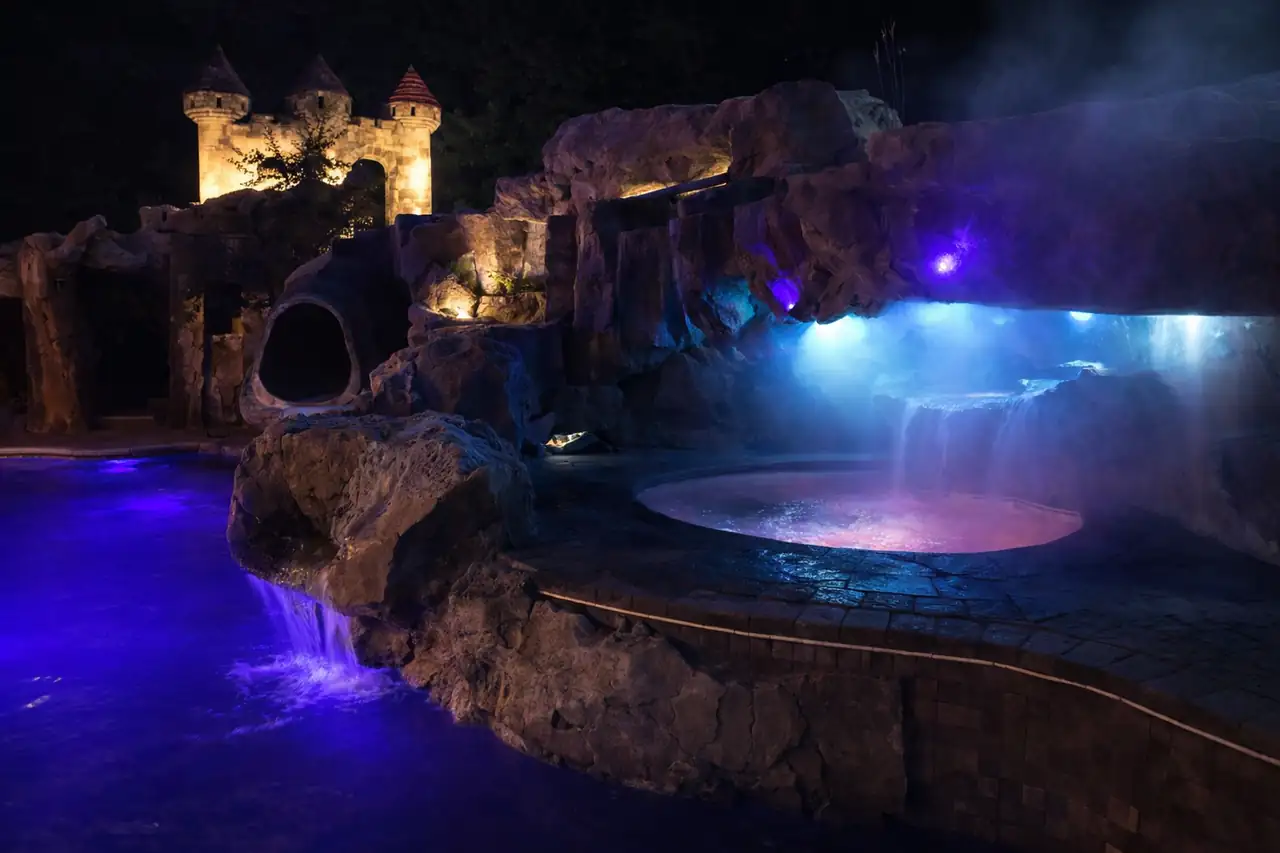
- Water Features — Fountains, waterfalls, and ponds built with hand-carved GFRC rockwork
- Retaining Walls — Terrace a sloped yard with carved concrete walls that match your patio texture
- Pool Decks — Slip-resistant carved concrete surfaces around pools
- Stamped Concrete — A lower-cost alternative with dozens of pattern options
- Concrete Overlays — Resurface an existing patio with a carved stone finish
- Hand-Carved Concrete & GFRC — How we carve and where GFRC is used
- Outdoor Living Spaces — Plan the patio, kitchen, fire and water elements as one build
Because everything is hand-carved concrete and GFRC, textures and colors match across the whole yard: patio, walls, kitchen, fire pit, and water features all read as one material.
Property Value and ROI
In the DFW real estate market, outdoor living space is a top-tier selling feature. A professionally installed patio with at least one integrated feature, such as a fire pit, kitchen, or seating wall, gives buyers usable outdoor space they would otherwise have to build themselves.
For homeowners planning to stay, the case is simpler. A hand-carved concrete patio costs a fraction of a natural stone installation while adding hundreds of square feet of usable living space that gets used 8-10 months a year in this climate. Because it lasts 50+ years with minimal maintenance, the long-term cost of ownership stays below any other patio material.
Ready to start your patio project? Contact us for a free on-site consultation and design estimate. We serve the entire Dallas-Fort Worth metroplex.
Last updated: