Fire Features & Outdoor Living DFW | Fire and Water
Texas Stone Craft plans and builds fire features as part of a whole Dallas-Fort Worth backyard: fire-and-water combinations, fire tables, and seat walls with fire built in. Basic fire features start around $2,000 and premium builds around $8,000. Most take 1-2 weeks on site. Gas and wood-burning both work, and we place them at least 10 feet from structures.
| Service | Fire features planned into a whole outdoor living space, fire-and-water combinations, fire tables, seat walls with integrated fire |
|---|---|
| Service area | Dallas-Fort Worth metroplex |
| Typical price range | $2,000+ basic fire feature, $8,000+ premium build |
| Typical timeline | 1-2 weeks on site for most fire features |
| Fuel options | Natural gas, propane or wood-burning |
| Materials | Hand-carved concrete and GFRC, with High Performance GFRC countertops rated to 450°F |
| Placement | At least 10 feet from structures, set for prevailing wind, seating flow and the view from indoors |
| Warranty | 5-year workmanship warranty |
| Why carved concrete instead of natural stone | One carved material can run through fire, water, seating and countertops, and it costs 40-60% less than natural stone |
Fire Features and Outdoor Living in Dallas-Fort Worth
Fire is the element that decides whether a backyard gets used after October. Texas Stone Craft designs and builds fire features across Dallas-Fort Worth as part of a complete outdoor living plan, in hand-carved concrete and GFRC carved on site to match everything around it.
This page is about planning. Where fire belongs on the lot, how it pairs with water and seating, and how to stage a larger yard over more than one season. For pricing by feature type, gas against wood-burning, and the permit and build sequence for a single unit, see our custom fire pits and fireplaces page.
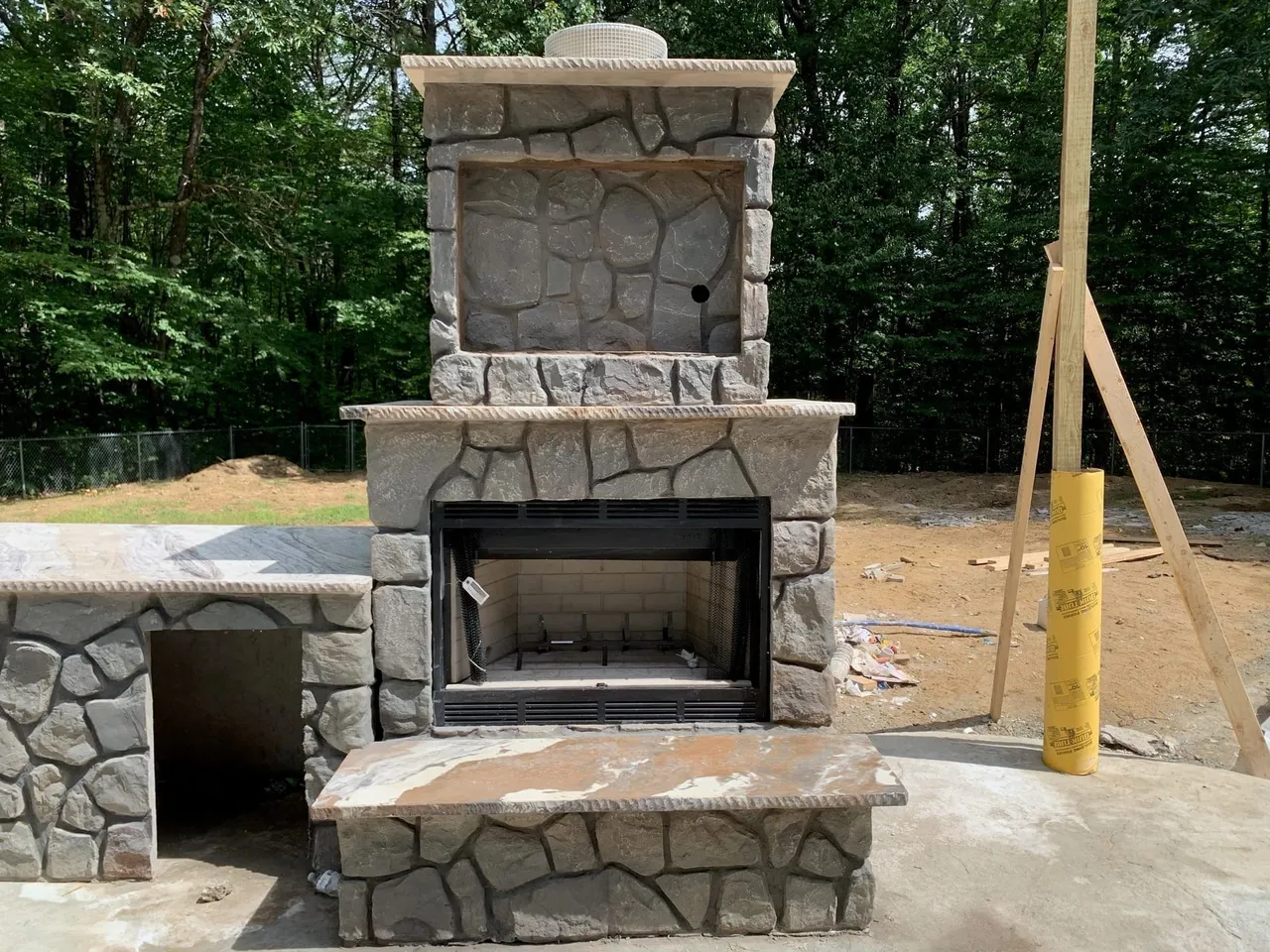
Why Add a Fire Feature?
- Extend Outdoor Living: Enjoy your patio even on cool evenings.
- Create Ambiance: A cozy focal point for gatherings and relaxation.
- Custom Designs: Round, square, rectangular, built-in seating, or standalone.
- Fuel Options: Gas or wood-burning to fit your lifestyle.
- Integrated Features: Combine with patios, outdoor kitchens, or pergolas.
Zoning a DFW Backyard Around Fire
Most backyards in this market get treated as one open space with a grill pushed against the house. A yard that gets used year-round is usually divided into three zones that each do one job.
The cooking zone sits closest to the kitchen door, because every trip for a forgotten pair of tongs goes through that door. The dining zone sits adjacent to it, under cover where the lot allows. The gathering zone, built around the fire, sits furthest out. That order matters. Fire pulls people away from the house, which is the whole point, and putting it at the far end of the sequence means guests move outward through the evening instead of crowding the back door.
Separation between zones does not need walls. A change in the carved surface texture, a step of six inches, or a low seat wall reads as a boundary without closing anything off. On a narrow lot, which describes a lot of established Dallas and Fort Worth neighborhoods, those soft dividers are the only ones that fit.
Fire and Water in the Same Sightline
Our signature combinations pair a flame with moving water so the focal point of the yard works in every month of the year. Water cascades alongside or around the flame, and the contrast between the two carries the view whether it is 40 degrees or 100.
The seasonal logic is simple. Fire earns its keep from October through March. Water earns its keep from May through September, when the sound covers traffic noise and evaporation cools the air within a few feet of the seating. Building only one of the two leaves the yard's centerpiece idle for half the year.
Practically, the two share more infrastructure than most homeowners realize. Both want power at the same end of the yard, both want a controller the client can reach from a phone, and both want their equipment hidden in the same enclosure. Running that work once, for both, costs meaningfully less than running it twice. Our water features page covers the water side in depth.
Seat Walls with Fire Built In
A seat wall that wraps a fire element turns a patio into a room. The wall gives permanent seating that never blows over, never needs storing in November, and never wanders to a neighbor's yard after a party.
The design question is how much of the circle to close. A full wrap seats the most people and feels the most enclosed, but it can trap smoke on a still night and it forces every conversation into one shape. A three-quarter wrap with a generous gap keeps the traffic path open and lets a breeze move through. On lots with a view worth keeping, we leave the wall low on that side and let the sightline run past the fire to whatever is beyond it.
We carve the wall, its cap and the patio in the same session with the same texture, so the assembly reads as one piece of rock rather than a kit. Construction specifications for these walls, including heights, depths and seating counts by configuration, live on the fire pits page.
Fire Tables and Dining-Height Features
A fire table puts the flame at the center of a dining surface, at the height where people are already sitting and eating. It suits smaller lots and covered patios where a ground-level ring would eat space the yard cannot spare.
The tops are GFRC rated for direct flame contact, with a surrounding ledge wide enough to set a glass down. Configurations range from a four-person round to a bar-height rectangle that doubles as standing space during a party. Because the table is the only fire element on many of these projects, it usually carries the same carved finish as the kitchen counter it faces.
Orientation, Wind and Smoke
Prevailing wind through the DFW warm season runs south-southeast. Cold fronts reverse that hard, and a north wind in January is exactly when a wood fire matters most. A fire element placed without regard to either will smoke somebody out on both ends of the year.
Three choices control the outcome. Placement relative to the house and fence lines decides where smoke collects. Elevation decides whether smoke drifts across the seating or rises above it. Fuel decides whether there is meaningful smoke at all, since a gas flame removes the question entirely. On tight lots hemmed in by six-foot fence on three sides, gas is frequently the only answer that works, because the fence traps smoke no matter how the ring is oriented.
One Material Through the Whole Yard
The strongest argument for carved concrete and GFRC on a whole-yard project is continuity. The same material, carved by the same crew in the same session, can form the fire surround, the seat wall cap, the patio surface, the water feature rockwork and the kitchen counter. Color and texture match because they were mixed and carved together rather than sourced from separate lots months apart.
Quarried material cannot promise that. A pallet ordered in spring and another ordered in fall come from different parts of the quarry and rarely match. Carved concrete also costs 40-60% less than natural stone, holds up at 4,000+ PSI, lasts 50+ years, and asks only for a reseal every 3-5 years.
Fire Features + Outdoor Kitchens
Fire features and outdoor kitchens are the perfect combination for year-round Texas entertaining. Our High Performance GFRC countertops offer 450°F heat resistance, making them ideal for integration with fire pits, fireplaces, and grilling areas. Create a seamless outdoor living space with coordinated GFRC finishes throughout.
Our Process
- Free Consultation: Discuss your vision, needs, and budget.
- Custom Design: 3D renderings and material selection.
- Construction: Expert installation with safety in mind.
- Final Walkthrough: Ensure your complete satisfaction.
Phasing a Larger Outdoor Living Project
Few clients build the whole yard at once, and there is no reason to. What matters is deciding the full layout before the first pour, then staging the build against the budget.
The rule that saves the most money is to put the buried work in early. Gas sleeves, electrical conduit and water supply for phases two and three go under the patio while the patio is open. A sleeve costs almost nothing at that stage. Cutting a finished carved surface two years later to chase a gas line costs real money, takes the patio out of service, and leaves a patch that an experienced eye can always find.
A common sequence runs patio and fire element first, seating and lighting second, kitchen third, water last. That order front-loads the part of the yard that changes how the space feels and defers the parts with the longest lead times on equipment.
Budget planning across phases works better when the layout is priced as a whole up front, even for the parts you will not build this year. A number on phase three today is not a quote you will hold us to in two years, but it tells you whether the plan you are drawing is the plan you can afford to finish. Clients who skip that step often build a phase one that assumes a phase two the budget was never going to reach.
Lighting and Power Around the Fire
A fire element gives light at exactly one height and one intensity, and it flatters faces at that height. Everything else in the yard has to be lit so it supports that rather than competing with it.
The mistake we correct most often is a single bright fixture on the back of the house aimed at the patio. It flattens the space, throws hard shadows past the seating, and makes the fire look dim by comparison. Low-level lighting works better: step lights in the risers, a soft wash grazing a carved wall face to bring out its texture, and path lighting that stops short of the gathering zone. The fire stays the brightest thing in the yard, which is the point.
Power planning belongs in the same conversation. A gathering zone needs circuits for lighting, for a water feature pump if one is coming, for speakers, and for the outlet somebody will want for a blender or a phone. Running one conduit during the patio phase covers all of it. Adding circuits later means either a surface-mounted run or another trench.
What Fire Does for a Yard Nobody Uses
Plenty of DFW backyards are well built and rarely occupied. The furniture is there, the grill works, and the family still eats inside. Adding fire changes that more reliably than adding square footage, for a straightforward reason: it gives people a destination and a reason to sit facing each other.
Heat is part of it from November through February, when a fire extends usable evenings on both ends of the season. The larger part is that a flame holds attention the way a screen does, without being a screen. Conversation lasts longer around it. That is the return most clients describe a year later, and it is the one no spreadsheet captures.
Featured Project
See our Stone Patio with Fire Pit in Southlake.
Related Services
- Custom Fire Pits & Fireplaces — Pricing, fuel choice, permits and the build sequence
- Outdoor Kitchens with GFRC Countertops — Integrate your fire feature with a custom outdoor kitchen for the ultimate entertaining space
- Stone Patios
- Water Features
- Outdoor Living Spaces
Ready to add warmth and style to your backyard? Contact us today for a free fire feature design consultation.
Last updated: