Water Features Fort Worth TX | Custom Waterfalls & Ponds
Texas Stone Craft builds hand-carved GFRC water features in Fort Worth: hillside cascades, creek-side koi ponds, pool waterfalls and courtyard fountains. Most run $5,000 to $35,000 and take 7-10 days on site. Western Fort Worth lots drop 8 to 12 feet across a backyard, and we build that fall into the design.
| Service | Hand-carved GFRC water features: hillside cascades, koi ponds, pool waterfalls and fountains |
|---|---|
| Service area | Fort Worth and Tarrant County, including Westover Hills, River Crest, Ridglea Hills, Tanglewood, Arlington Heights and the Trinity River corridor |
| Typical price range | $5,000-$10,000 basic waterfall, $8,000-$18,000 pond and waterfall without fish, $25,000-$40,000+ koi pond, $15,000-$25,000 premium feature, $15,000-$40,000+ grotto |
| Typical timeline | 7-10 days for a pondless cascade, a pool waterfall, a grotto or a large pond |
| Materials | GFRC, hand-carved on site, rated up to 4,000 PSI |
| Permits | Fort Worth Development Services handles plumbing and electrical permits. Plan review runs 2-3 weeks. Creek setbacks apply near the Trinity and its tributaries. |
| Ground conditions | Limestone bluff under clay west of the Trinity, deeper alluvial soil east and along the river |
| Warranty | 5-year workmanship warranty |
| Why GFRC instead of natural stone | Far lighter than solid stone, so a hillside feature needs far less footing, and it costs 40-60% less |
Water Features for Fort Worth's Hillside Lots
Water features in Fort Worth get built on a slope more often than anywhere else we work. West of the Trinity the residential terrain is the steepest in the metroplex, and a backyard in Ridglea Hills or Westover Hills can fall 8 to 12 feet between the patio door and the back fence. Most crews treat that as a problem to flatten. We treat it as most of the design already being in the ground. As a water feature contractor in Fort Worth, we let the hill supply the height and spend the budget on carving.
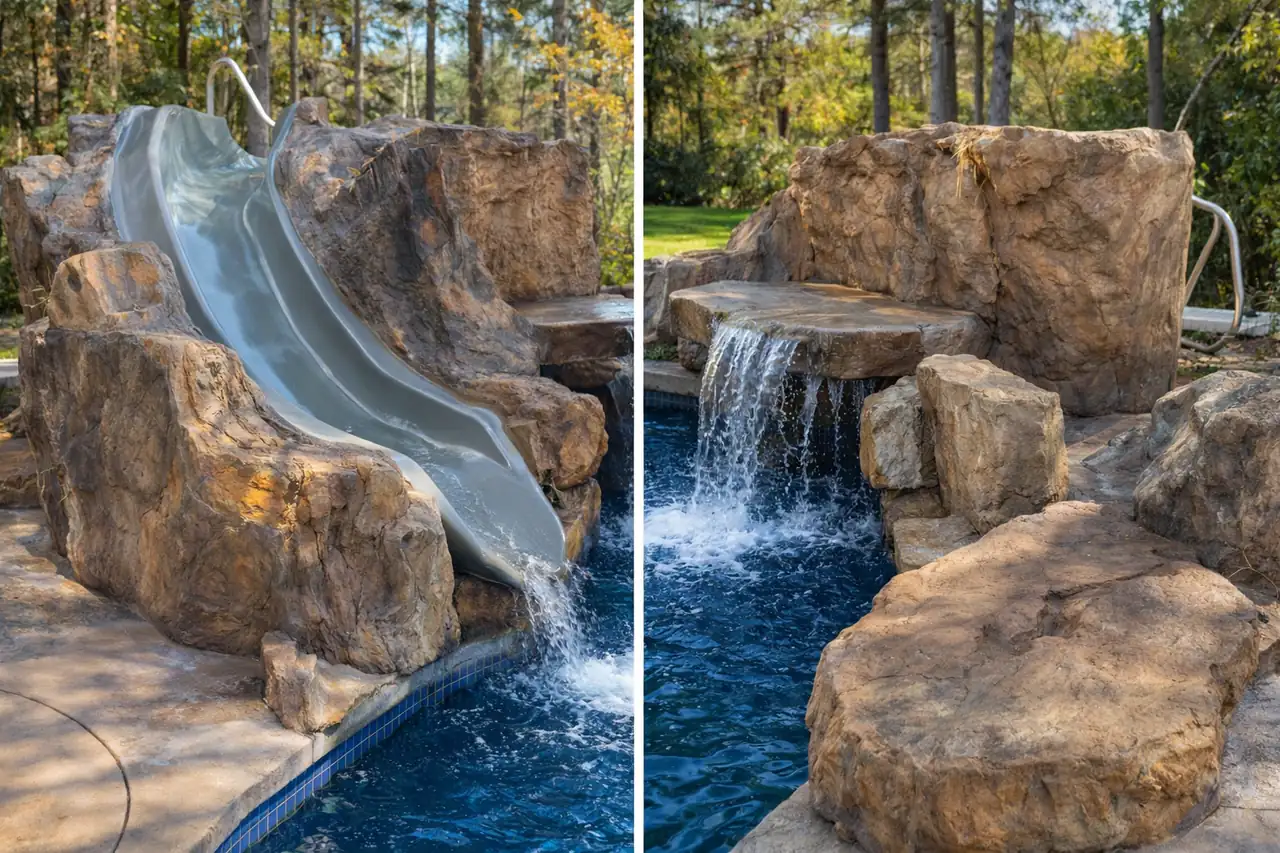
Texas Stone Craft hand-carves every rock face on site, in Glass Fiber Reinforced Concrete rather than stacked stone. On a hillside that choice does real work. As a thin carved shell, far lighter than solid stone, a four-tier cascade needs a fraction of the footing, which matters when the footing is cut into a slope. It also costs 40 to 60 percent less than the equivalent stone build.
Water Feature Installation in Fort Worth on an 8-Foot Grade
On a flat Arlington or Crowley lot, a multi-level water feature is a built structure. Every inch of drop has to be constructed and paid for. In west Fort Worth the drop already exists, so the budget goes into carving and finish instead of into height.
We bench each pool into the slope, set it on its own footing, and let the water fall between levels on natural grade. A single return line carries it back to the top. A four-tier run of 40 feet with 7 feet of total fall is a routine build here and an expensive one almost anywhere else in DFW.
The grade brings two constraints with it. Equipment has to reach the low end of the yard, and on a tight side yard that means smaller machines and more hand work. Water that falls also has to go somewhere at the bottom, so every hillside feature gets a drainage plan before it gets a rock plan.
What the Ground Does on Each Side of Town
West of the Trinity: Limestone Bluff Under Clay
The bluff neighborhoods sit on limestone with a clay layer on top. Once a footing reaches rock, bearing is excellent and nothing settles. Getting there is the work, and the clay above is the complication: it swells wet, shrinks dry, and tends to move water sideways along the top of the rock. A feature founded partly on clay and partly on rock will crack at the transition, so we take the whole footing to one or the other.
East of the River: Alluvial Bottom Soil
Down in the river bottoms and east toward Haltom City the soil is deeper, softer and holds more water. There is no rock to reach at a sane depth. Footings get wider instead of deeper, and drainage becomes the main engineering question rather than an afterthought. Ponds do well on this ground because it already holds moisture.
We dig test holes on every property before pricing the foundation. Two houses on the same street can sit on different ground.
Which Water Features Suit Fort Worth Terrain
Hillside Cascades and Streams
The signature Fort Worth build. Water starts at an upper bench and works down through carved pools, disappearing and reappearing between rock shelves. Runs of 30 to 60 feet are common on the west side. Flow sits between 40 and 90 GPM depending on how wide the drops are.
Creek-Side Ponds
Properties backing onto Sycamore Creek, Mary's Creek or the Trinity get ponds set back from the bank, footed below the erosion line, with overflow routed away from the water rather than into it. Existing bank vegetation usually stays, and the carved rock edge ties the pond into it. A koi pond here gets a heavy liner, then a reinforced concrete shell we build over it, then the carved rim. We won't build a bare liner with rock dumped on it, and the shell plus the filtration koi need are why a Fort Worth koi pond runs $25,000-$40,000+. Homeowners on those creeks who call us as pond builders near Fort Worth want the pond close to the bank, and we set it as close as the city's creek setback allows.
Pool Waterfalls on Sloped Decks
A pool on a graded lot often sits with a retaining wall or a raised bond beam on the uphill side. That wall is the natural place for a waterfall, and building it there means one structure holds soil and moves water at the same time.
Small Recirculating Fountains
For the smaller lots in Fairmount, Arlington Heights and around TCU. These run $3,500 to $8,500, install in 7-10 days, and suit a courtyard or an entry more than a back garden.
Creek Setbacks and the Fort Worth Permit Process
The city reviews anything with a pump motor or a plumbing connection. Plan review takes about two to three weeks, longer when a property sits inside a creek setback and drainage review gets added.
The setback is the part homeowners get caught by. A pond that looks fine on a sketch can land inside a protected buffer, and finding that out after excavation is expensive. We pull the setback line from survey before design starts. Where a neighborhood association also reviews exterior work, we prepare that submittal alongside the city application.
Neighborhoods We Work In
Westover Hills and River Crest
Estate properties with mature trees and serious grade. Features here run large, carved in cut limestone and ashlar textures that match the architecture, and positioned to be seen from the house rather than discovered in the yard.
Ridglea Hills and Tanglewood
The steepest mid-size lots in the city. Multi-tier cascades and streams are the common request, often combined with terracing the yard needed anyway.
Arlington Heights, Fairmount and the Near Southside
Craftsman and bungalow neighborhoods with smaller, flatter yards. Courtyard fountains, compact pondless cascades, and ledgestone or dry-stack textures that suit the period of the houses.
Far North Fort Worth and the Alliance Corridor
Newer construction on larger, flatter lots. Backyards are often blank, and features here tend to be the centerpiece of a first outdoor buildout rather than an addition to an established garden.
What a Fort Worth Water Feature Costs
Basic waterfalls run $5,000 to $10,000. A fish-free pond with a waterfall lands at $8,000 to $18,000 depending on size and filtration. Stock it with koi and the filtration alone pushes the build to $25,000-$40,000+. Premium multi-drop features with lighting run $15,000 to $25,000. A grotto with seating and audio goes $15,000 to $40,000 or more.
Where the Money Goes on a Sloped Lot
Access is the first line item. If a machine cannot reach the low end of the yard, excavation becomes hand work and the labor doubles. Long plumbing and electrical runs from the equipment pad to a feature 80 feet downhill add conduit, wire and trench. Footings that have to chase limestone through clay cost more than footings in uniform ground. Creek work adds survey and, on some slopes, bank stabilization below the feature.
Three Fort Worth Projects
Ridglea Hills Four-Tier Cascade
A backyard falling 9 feet across 45 feet. We benched four pools into the slope, carved them in a layered limestone texture keyed to the house, and ran 60 GPM down the whole length. A single 2-inch return line carries water back to the top pool. Low-voltage lighting picks out each drop after dark. Fifteen working days including the city permit.
Sycamore Creek Koi Pond
A 14 by 18 foot pond for a homeowner backing onto the creek, set 20 feet off the bank to clear the setback and footed below the erosion line. Filtration is sized to the fish load, mechanical ahead of biological, running from a vault near the equipment pad. Overflow routes to a dry well away from the bank rather than over it.
Tanglewood Pool Waterfall
A pool with a 4-foot raised bond beam on the uphill side. We built the waterfall into that wall so one structure retains the slope and carries the falls. The carved texture matches the existing coping. The homeowner runs it off a dedicated pump, so the falls work whether or not the filter is cycling.
Upkeep Through a Fort Worth Year
Skim debris out of the basin through the fall. Check the pump screen monthly during heavy leaf drop. In February, if a hard freeze is forecast, run the feature or drain the lines, the same as you would a pool. GFRC does not absorb water, so there is nothing in the shell to expand, but exposed plumbing still freezes.
Reseal every three to five years. Beyond that the upkeep is filtration on ponds and close to nothing on pondless builds.
Hillside features have one seasonal job the flat-lot ones do not. After a heavy spring storm, walk the drainage line at the bottom of the run and make sure it is clear. West Fort Worth yards shed a lot of water fast, and a blocked outlet backs it up against the lowest pool. Five minutes with a rake in April saves a callout in June.
What Property Value a Water Feature Adds in Fort Worth
On Fort Worth's west side, from Ridglea and Tanglewood to Westover Hills and River Crest, a finished backyard is assumed rather than admired, and an unlandscaped slope reads as work the buyer still has to do.
A carved cascade changes what the slope means. Instead of a grade problem the listing has to explain, it becomes the reason the lot is worth more than the flat one two streets over. That argument only works when the feature looks like it belongs to the terrain, which is the whole case for carving on site rather than setting a pre-cast unit into a hill.
A feature generally holds much of its cost at resale, and it matters most on the properties where the backyard was the reason the buyer looked in the first place.
Book a Site Visit in Fort Worth
Contact us today for a free assessment. We will walk the grade, dig test holes to see what the footing has to sit on, check the setback if you back onto a creek, and put together a written proposal with renderings and real pricing. We bring material samples and photos of finished Fort Worth work.
Water Features Across DFW
We design and install water features throughout the Dallas-Fort Worth metroplex. Explore our city-specific services:
- Water Features Aledo — Bedrock-anchored water features for Parker County rock lots
- Water Features Allen — Contemporary water features for Allen's new-build communities
- Water Features Rockwall — Waterfront water features near Lake Ray Hubbard
- Water Features Southlake — Architectural water features for Southlake estates
- Water Features Dallas — Custom water features for Dallas homes
- Water Features Arlington — Pool grottos, waterfalls, and family-friendly water features
- Water Features Plano — HOA-approved ponds and waterfalls for Plano estates
- Water Features Frisco — Modern LED-lit features for master-planned communities
- Water Features Grapevine — Lakeside water features near Grapevine Lake
- Water Features Haslet — Acreage water features for Alliance corridor properties
- Water Features Keller — Creekside water features for Keller's larger lots
- Water Features Colleyville — Private water features for established Colleyville estates
- Water Features Crowley — Affordable water features for flat clay lots
- Water Features Burleson — Pool remodel waterfalls for Burleson and Johnson County lots
- Water Features Flower Mound — Terraced water features for Flower Mound's master-planned communities
- Water Features Mansfield — Family water features for Mansfield's newer subdivisions
- Water Features McKinney — Naturalistic ponds, streams, and boulder waterfalls
- Water Features Northlake — New-community water features for Harvest and Pecan Square
- Water Features Prosper — Estate-scale water features for luxury properties
- Water Features Westlake — Acre-lot estate water features for Vaquero and Glenwyck Farms
- Water Features Granbury — Lake-lot falls, grottos and koi ponds for Hood County rock lots
Related Services for Fort Worth Homeowners
- Outdoor Kitchens Fort Worth — Integrated outdoor living
- Retaining Walls Fort Worth — Terraced wall integration
- Fire Pit Installation in Fort Worth — Gas and wood-burning pits planned with the water feature
- Main Water Features Page — Complete information
Last updated: