Pool Decks DFW | Stamped Concrete & Carved Stone
Texas Stone Craft builds pool decks across Dallas-Fort Worth in stamped and hand-carved concrete. Stamped surfaces start at $9 per square foot and carved stone finishes at $12. Cool-deck additives pull surface temperature down 20 to 30 degrees, and every deck is sloped a minimum quarter inch per foot away from the water.
| Service | Pool deck construction and resurfacing in stamped concrete, hand-carved concrete and GFRC |
|---|---|
| Service area | Dallas-Fort Worth metroplex, Collin, Dallas, Denton and Tarrant counties |
| Typical price range | $9+/sq ft stamped concrete, $12+/sq ft carved stone finish |
| Typical timeline | 2-3 days for an overlay on a sound deck, longer for a new pour with tear-out |
| Materials | Air-entrained concrete rated up to 4,000 PSI, 4-6 inches thick, cool-deck additives and anti-slip sealer |
| Surface temperature | Cool-deck additives and light tones drop surface temperature 20-30°F against standard gray concrete |
| Permits | Deck resurfacing rarely needs one. New decking tied to pool structure or drainage usually does, and we pull it. |
| Warranty | 5-year workmanship warranty |
| Why carved concrete instead of natural stone | 40-60% less installed than natural stone, no grout joints for algae, and one continuous surface with no loose units to shift underfoot |
Pool decks take more abuse than any other surface on a property. They get walked on barefoot at 105 degrees, splashed with chlorinated or salted water several times a day, scrubbed with sunscreen oils, and left under full Texas sun for eight months a year. Texas Stone Craft builds pool decks across Dallas-Fort Worth in stamped and hand-carved concrete engineered for that specific set of conditions, with cool-deck finishes, wet-area traction and drainage that moves water away from the water.
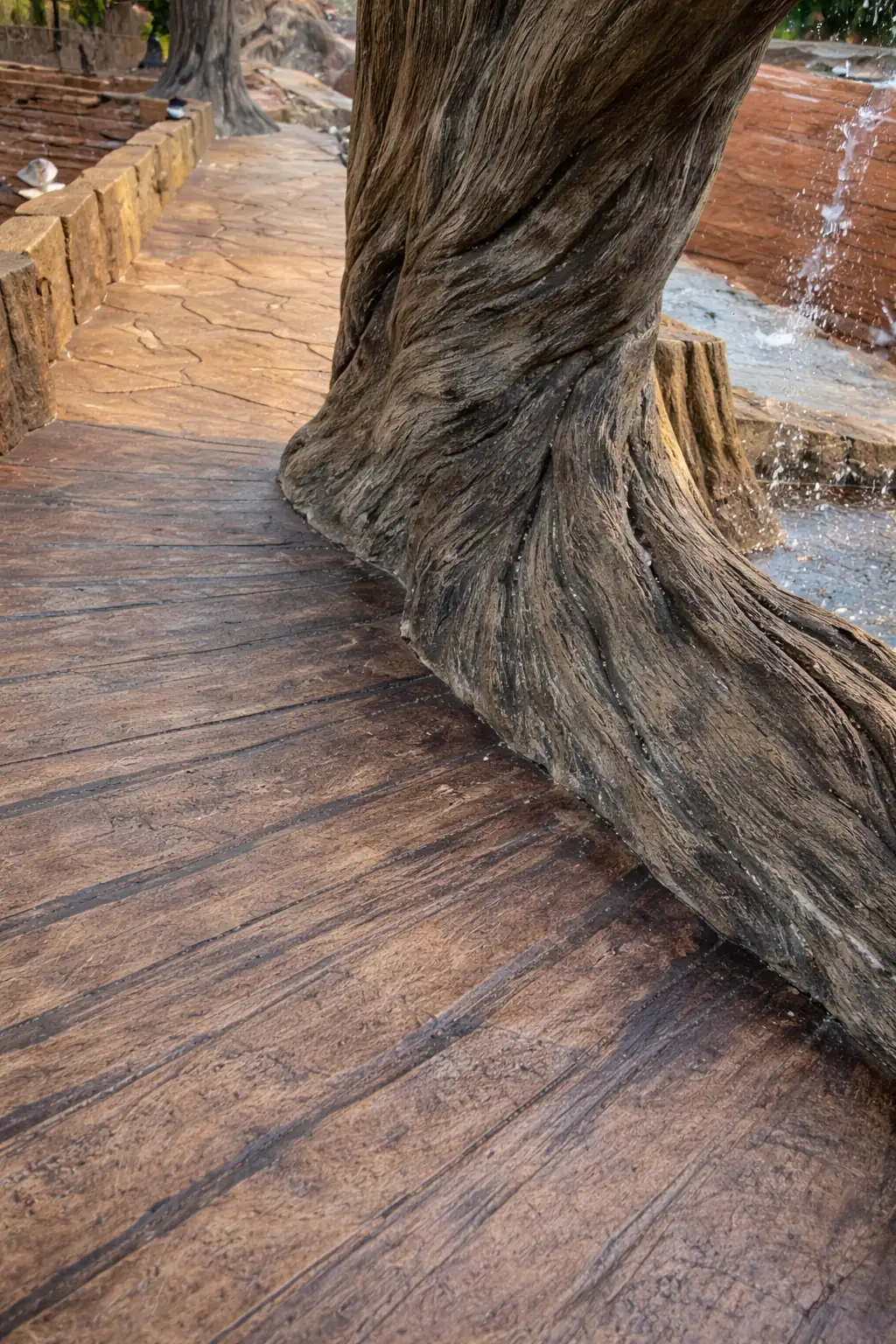
Surface Temperature Is the First Decision
In July a standard gray slab in full sun becomes unusable for bare feet by mid-morning. Three things bring that down, and we use all of them together.
Cool-deck additives reflect and dissipate solar gain rather than storing it, and they pull surface temperature down 20 to 30 degrees against standard gray concrete. That is the difference between a deck people cross quickly and one they stand on.
Color contributes as much as the additive. Light tan, bone and pale gray reflect substantially more than charcoal or deep brown. Clients often arrive wanting a dark, dramatic deck, and we show them the tradeoff in daylight before anything is ordered.
Texture is the third lever. A broken, tooled surface presents less flat area to direct sun than a smooth troweled one, and it also holds a thin layer of moving air against the surface. Where the deck runs wide and unshaded, we recommend planning shade structures into the layout rather than treating them as a later addition.
Traction in the Wet Zone
The first few feet out from the coping stay wet all summer, and that band is where every slip happens. We treat it as its own specification rather than running one finish across the whole deck.
Stamped and carved textures create the base traction, because a broken surface breaks the water film that makes smooth concrete dangerous. On top of that we blend a fine polymer grit into the sealer for the wet zone. It disappears visually and gives bare feet a bite without being abrasive enough to scrape knees.
Texture depth is a balance we set deliberately. Too shallow and it does nothing wet. Too deep and it collects sunscreen residue, holds algae on shaded elevations and hurts to kneel on. Shaded north-facing sections and anything under a tree canopy get extra attention, since those are where organic growth takes hold first.
Chlorine, Salt and What Protects the Slab
Concrete is not damaged by a swimming pool overnight. It is worn by repetition. Chlorinated splash-out mildly etches unsealed surface paste over years. Sanitizers, pH adjusters, algaecides and clarifiers all land on the deck in concentrated form when they are added. Sunscreen oils stain. Salt is the harshest of the group, because it crystallizes inside surface pores as it dries and pushes outward from within.
The sealer takes that punishment, not the concrete. For saltwater systems we specify chemical-resistant formulations and hold firmly to the 2 to 3 year resealing schedule. A deck that gets resealed on time will outlive the pool equipment several times over. A deck that goes eight years between coats develops a chalky, porous surface that no longer cleans properly.
Rinsing splash-out with fresh water after heavy use costs nothing and measurably extends the finish. So does sweeping leaf litter off promptly, because decomposing organic matter both stains and feeds algae in the texture.
Drainage Away From the Water
Every deck we build falls a minimum of a quarter inch per foot away from the pool. That number is not decorative. Water running toward the pool carries lawn fertilizer, dirt, and whatever chemistry landed on the deck straight into the water, which then costs the owner in chemistry to correct.
Water standing on the deck is the other failure. It wears sealer in patches, feeds algae in the texture, and creates exactly the slip condition the surface texture was chosen to prevent. Where the site does not allow a clean fall to landscape, we build drainage channels into the deck layout and set deck drains at the low points.
On resurfacing work, drainage gets corrected before anything decorative goes down. A deck that has settled toward the pool will do the same thing to a new surface within a season or two, so the grading fix comes first even when it adds a day.
Joints, Coping and Equipment Access
North Texas clay moves, and a pool shell and a deck slab sitting in it move at different rates. We place an isolation joint between the two with a compressible filler so neither cracks the other. The same treatment applies where the deck meets the house foundation, raised beds, columns and equipment pads.
Control joints inside the deck field are cut on a grid sized to slab thickness and placed at re-entrant corners where cracking starts. On stamped and carved work we run them along pattern lines where the layout allows, so they read as part of the design.
Coping is the transition everybody notices. New decking terminates at full thickness against the coping rather than feathering out to a thin edge that will chip. Where clients want the surface to read as continuous, carved concrete can be carried over the coping line as a cantilever detail with a rounded, foot-friendly edge.
Equipment access gets planned during layout. Pumps, filters, heaters, automation panels and cleaning equipment all need to be reachable years from now, so access panels and service routes are set before the pour rather than cut in afterward.
Resurfacing an Existing Deck
Many DFW pools were built in the 1990s and 2000s with plain broom-finished decking that has since faded, spalled or stained. If the slab is structurally sound, an overlay bonded over the top converts it to stamped or carved work in 2 to 3 days without demolition.
Soundness is the gate. We sound the deck for hollow spots where the old finish has delaminated, check that it still drains correctly, look at crack width and whether the cracks are still moving, and assess how the surface meets the coping. Sound decks with cosmetic problems are ideal candidates. Decks that have settled, heaved or broken into sections at different heights need those issues addressed first, and we will say so rather than resurface over a moving slab.
Pattern and Color Around Water
A pool deck is looked at from more angles than any other hardscape on a property. People see it from the water, from the patio door, and from upstairs windows. That last view is the one that exposes a repeating pattern, because a mat repeat invisible at ground level lines up into obvious rows when you look down on it.
On decks over roughly 600 square feet we usually recommend hand-carved work or a seamless texture for that reason. Carved surfaces have no repeat to find, since every stone is cut individually and the joint lines are drawn rather than pressed. Where budget favors stamped work on a large deck, we mix two or three mats and rotate them so the eye cannot lock onto a grid.
Color gets pulled from what is staying. Coping, waterline tile, house brick and any existing stone on the property set the range before we open a sample box. Water also changes perception, since the reflected light off a pool throws blue-green onto everything within a few feet of the edge, and a tone chosen indoors can read cold once the deck is wet and lit.
Borders earn their cost around a pool. A contrasting band at the coping edge frames the water, gives the field a clean termination, and marks the wet zone visually for anyone walking it at night.
Lighting Built Into the Deck
Pools get used after dark for most of the Texas season, so lighting is part of the deck rather than an accessory bolted on later. We set conduit and boxes before the pour, because retrofitting low-voltage runs into a finished deck means cutting the surface we just built.
Step lights go into any elevation change, and around a pool that includes the coping edge, raised beam walls, spa steps and any grade transition out to the lawn. Perimeter lighting washes the deck edge and makes the boundary between deck and landscape readable at night. Uplighting picks up water features, planting and any carved rock work in the surround.
All of it runs on low-voltage systems rated for wet locations, with transformers and controls sited where they stay dry and stay reachable. Color-changing LED is standard now and most clients tie it into the same automation that runs the pool.
Build Sequence on a New Deck
Layout comes first, marked on the ground so you can walk the shape before anything is excavated. We set finished elevations off the coping and confirm the fall away from the water at every point on the perimeter.
Excavation and base follow, with aggregate compacted in lifts. Reinforcement goes in on chairs so steel sits in the middle third of the slab. Isolation joints are formed at the pool shell, house foundation and equipment pads at this stage rather than cut later.
We place concrete rated up to 4,000 PSI, air-entrained for freeze-thaw resistance, 4 to 6 inches thick, with cool-deck additives where specified. Stamping or carving happens in the working window, edges and coping transitions are detailed by hand, and control joints are cut once the slab has set.
Color and sealer close the job. After cure, we wash, apply antiquing where the design calls for it, and roll two thin coats of anti-slip sealer. Final walkthrough covers drainage testing, maintenance instructions and the resealing date.
Maintenance Schedule
Weekly: sweep or blow debris off the deck and rinse splash-out with fresh water, particularly on salt systems.
Seasonally: brush the textured areas on shaded elevations to keep algae from establishing in the low points.
Every 2 to 3 years: power wash and reseal. Keep the washer under 1500 PSI, because higher pressure strips sealer and opens the surface.
Avoid: acid cleaners, metal shovels, and dragging furniture across the surface without pads under the feet.
Service Areas
We build and resurface pool decks throughout the Dallas-Fort Worth metroplex:
- Dallas
- Fort Worth
- Plano
- Frisco
- McKinney
- Allen
- Prosper
- Southlake
- Keller
- Colleyville
- Grapevine
- Flower Mound
- Lewisville
- Carrollton
- Irving
- Grand Prairie
- Arlington
- Mansfield
- Denton
Contact Texas Stone Craft for a consultation and estimate.
Related Services
- Water Features — grottos, waterfalls and spillways built into the pool surround
- Stamped Concrete — pattern and color options across patios and drives
- Concrete Overlays — resurfacing systems for slabs already in the ground
- Hand-Carved Concrete Patios
- Outdoor Living Spaces
Featured Projects
See our Stamped Concrete Overlay Patio in Southlake for an example of resurfacing a sound slab.
Learn More
Read our post on Concrete Pool Grottos for how water features tie into the deck.
Browse our Gallery to see finished pool deck work.
Last updated: