Hand-Carved Concrete & GFRC DFW | Carved Stone Look
Texas Stone Craft hand-carves concrete and GFRC in Dallas-Fort Worth to replicate quarried rock on patios, retaining walls, water features and fireplace surrounds. Carved concrete patios start at $8 per square foot and GFRC retaining walls at $25 per square foot. The work is carved on site, runs 40-60% less than natural stone, and lasts 50+ years with a reseal every 3-5 years.
| Service | Hand-carved concrete and GFRC for patios, walkways, retaining walls, water feature rockwork and fireplace surrounds |
|---|---|
| Service area | Dallas, Fort Worth, Plano, Frisco, McKinney, Southlake, Keller, Prosper and the wider DFW metroplex |
| Typical price range | $8+ per square foot carved concrete patio, $25+ per square foot GFRC retaining wall |
| Typical timeline | Days rather than weeks on most residential installations |
| Materials | Hand-carved concrete and Glass Fiber Reinforced Concrete, carved on site, not stamped from molds |
| Maintenance | Periodic cleaning and a reseal every 3-5 years, with no joints to repoint |
| Service life | 50+ years when properly installed |
| Warranty | 5-year workmanship warranty |
| Why carved concrete instead of natural stone | 40-60% less expensive than natural stone, will not split or settle, and forms curves that quarried material cannot |
Hand-Carved Concrete & GFRC in Dallas-Fort Worth
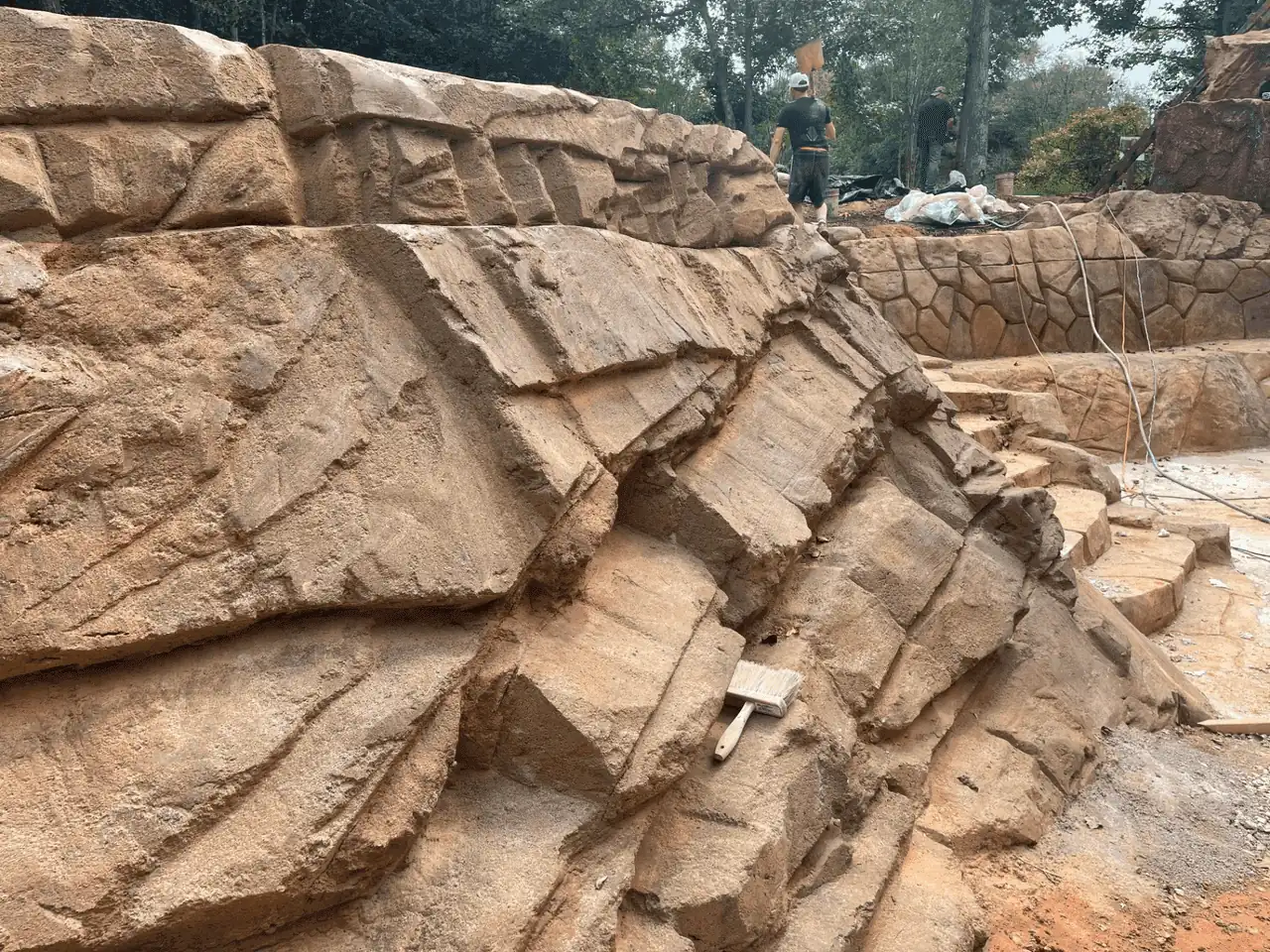
Get the look of natural stone without the cost and the maintenance that comes with it. Texas Stone Craft specializes in hand-carved concrete and GFRC (Glass Fiber Reinforced Concrete) that replicates limestone, fieldstone and boulder textures with a realism that holds up at arm's length, at 40-60% less than natural stone.
Everything on this page is carved concrete. We do not install quarried material, and the slug on this page is historical. What we build looks like rock and behaves like engineered concrete, which is the combination most DFW homeowners are after once they price both.
Our Hand-Carved Concrete Services
- Carved Concrete Patios: Realistic rock textures hand-carved on site
- GFRC Retaining Walls: Lightweight, engineered walls with a carved rock face
- Carved Walkways: Pathways with organic edges and layered color
- Water Feature Rockwork: Hand-carved boulders and cascades
- Outdoor Fireplace Surrounds: Carved surrounds with depth and shadow
- Pool Grottos: Custom carved caves and rock formations
Why Choose Hand-Carved Concrete Over Natural Stone
- Authentic Appearance: Hand-carved textures that read as real rock at conversational distance
- Superior Strength: GFRC and reinforced concrete outlasts natural stone
- Cost Effective: 40-60% less expensive than natural stone
- Faster Installation: Complete projects in days, not weeks
- No Loose Stones: No individual stones to split, loosen or pop out
- Custom Shapes: Curves and forms that quarried material cannot produce
The cost gap is the part that surprises people, and it is not only the material. Quarried rock is heavy, which drives freight, handling and foundation. Carved concrete arrives as bulk material and leaves the truck as a finished surface, so a large share of the labor that a masonry crew spends moving weight goes into carving instead.
The Textures We Carve
Our artisans work the surface with specialized tools while the material is still green, building textures that replicate:
- Texas Limestone: Smooth ledges with weathering patterns and horizontal bedding
- Fieldstone: Rounded, weathered forms with softened edges
- Stacked Ledgestone: Layered horizontal courses with deep shadow lines
- Boulder Formations: Large rock masses for water features and grottos
- Cliff Face: Vertical, broken texture for retaining wall elevations
Color does as much work as texture. A single-color surface reads as concrete no matter how well it is carved. We layer a base integral color, then apply stains in two or three passes, concentrating pigment in the recesses the way weather and mineral deposit would put it there. That layering is what survives close inspection.
Where Carved Concrete Goes
Patio & Hardscape Applications
Transform outdoor spaces with hand-carved patios that read as authentic rock. We carve realistic textures, natural edges and color variation that make each installation unique. Unlike quarried material set on a base, a carved surface resists shifting or settling into a trip hazard, because it is a single reinforced element rather than a field of separate units.
GFRC Retaining Wall Construction
Glass Fiber Reinforced Concrete walls combine strength with lightweight construction. We hand-carve each face to replicate the rock formations of the region. Engineered with integrated drainage behind them, these walls last 50+ years. The drainage is the part that decides whether a wall survives, and it is the part most commonly skipped on a budget installation. Our retaining walls page covers the engineering in full.
Water Feature Rockwork
Waterfalls, pool grottos and pond edges are where carving earns its reputation, because water reveals everything. A poorly carved edge shows a straight line the moment water runs over it. We carve the lip to break the flow the way a real ledge would, and we build the surrounding formation as one continuous mass so there is no seam for water to find. See our water features page for the systems behind them.
Outdoor Fireplace & Fire Pit Surrounds
Carved surrounds give a fire element the visual weight it needs without the foundation a heavy assembly would demand. Texture creates depth and shadow around the firebox, and the material handles the heat cycling that opens joints in conventional masonry over time. Our fire pits page covers the fire hardware itself.
Our Hand-Carving Process
- Free Consultation: Discuss your vision and the rock textures you are drawn to
- Custom Design: Choose textures, patterns and color schemes
- Structural Engineering: Proper foundation work and reinforcement
- Carving Mix: Pour the footing or slab, then stack a high-strength carving mix onto the steel by hand, in layers, for walls and features, or place GFRC panels
- Hand-Carving: Artisans carve realistic textures on site
- Coloring & Staining: Multi-layer color application for an authentic result
- Sealing: Professional-grade sealers protect your investment
The carving window is the part that sets the schedule. Once material is placed, the crew has a limited period while it stays workable, which is why carving days are staffed heavily and why weather moves them. We would rather reschedule a carving day than carve a surface that is setting faster than the tools can follow.
Maintenance & Longevity
Hand-carved concrete asks for minimal maintenance, far less than quarried material. Periodic cleaning and an occasional reseal every 3-5 years keeps surfaces looking new. No re-mortaring joints, no replacing cracked units, and none of the settling that pulls a conventional installation out of level.
Sealer choice matters more than sealer frequency. A film-forming product looks impressive for a season and then peels in sheets under Texas UV. We use penetrating sealers that soak into the surface, which look less dramatic on day one and considerably better in year four.
Two things do shorten the interval between reseals. Full afternoon sun on a west-facing surface works the color harder than a shaded north side, so a large patio sometimes wants its exposed half done a year ahead of the rest. Chlorinated splash-out around a pool does the same thing along the waterline, and that band is worth checking each spring even when the rest of the deck looks fine.
Stains from ordinary use come off more easily than most people assume. Grease from a grill, tannin from oak leaves left wet through a winter, and rust from a planter foot all lift with a mild cleaner and a stiff brush as long as the sealer is intact. That last clause is the whole argument for keeping up with the reseal: a sealed surface holds the spill at the top where it can be washed away, while an unsealed one lets it into the concrete where removal turns into a much larger job.
How Carved Concrete Compares
Against natural stone, carved concrete costs 40-60% less, installs in days instead of weeks, and forms shapes a quarry cannot supply. Against flagstone, travertine, slate or pavers set on a sand base, it eliminates the joints where weeds establish and where units drift out of alignment as the base moves. Against stamped concrete it costs more and takes longer, and it buys a surface with no repeating pattern.
None of those are absolutes. A small straight walkway with a tight budget is a reasonable stamped job, and we will tell you so. The carved work pays for itself where the shapes are irregular, where the texture is seen up close, or where the installation has to match something that already exists.
What Carving on Site Actually Involves
Homeowners are often surprised by how the crew works, so it helps to know what the days look like before they happen.
Placement day is the loud one. Material arrives, gets placed and screeded to grade, and the crew waits for it to reach the right stage. That window is not on a clock. Temperature, humidity and wind all move it, which is why a carving day in August starts earlier than one in March and why a windy afternoon shortens it.
Carving happens by hand with a set of tools that would look more familiar to a sculptor than to a concrete crew: trowels ground to custom profiles, texture skins, chisels and brushes. The artisan lays out the major joint lines first, establishing where the ledges break and how the courses stack, then works back across the surface adding the smaller texture that reads from a few feet away. The sequence matters. Texture applied before the joint layout looks busy and directionless.
Color goes on over the following days in layers, each one thinner than homeowners expect. The first pass looks wrong to almost everybody who watches it, because a single tone across carved relief reads flat and artificial. The depth arrives with the second and third passes, when pigment is concentrated into the recesses and wiped back off the high points.
Sealing closes the process after the surface has cured enough to accept it. Rushing that step traps moisture and clouds the finish, so it waits.
Choosing Between Carved Concrete and Quarried Material
The comparison is worth making honestly, because carved concrete is not the right answer on every project.
Carved concrete wins on cost, on shape freedom, on speed, and on the absence of joints. It wins decisively on anything curved, anything vertical that would otherwise need a heavy foundation, and anything where water runs across the surface. It wins on matching, because color is mixed to the site rather than selected from whatever the quarry produced that season.
Quarried material wins where a client specifically wants the material itself, knows the difference, and values the provenance. Some people want real rock because it is real rock, and no amount of carving satisfies that. We are straightforward about it rather than arguing the point.
What tips most DFW decisions is the soil. Expansive clay punishes heavy assemblies set on separate footings, and it punishes anything with joints that can open. A carved surface tied together with steel handles that ground better than a field of individual units does, and the lighter weight of GFRC reduces what the foundation has to carry in the first place. On a lot with active clay, that is usually the argument that settles it.
Service Areas
We provide carved concrete installation throughout the Dallas-Fort Worth metroplex, including Dallas, Fort Worth, Plano, Frisco, McKinney, Southlake, Keller, Prosper and surrounding communities.
Conditions change enough across that footprint to affect the work. Lots on the eastern side of the metroplex sit on deep blackland clay that moves substantially between a wet spring and a dry August, which drives reinforcement and foundation decisions. Move west of Fort Worth and the profile shifts toward sandy loam over shallow limestone, where the rock is excellent bearing material once a footing reaches it but where excavation costs more to get there. Neither condition rules anything out. Both change how a job is built, and the difference is one more reason we price from a site visit rather than from a square-foot number over the phone.
Ready to bring a carved rock look to your outdoor space?
Contact us today for a free consultation and estimate.
Related Services
Featured Projects
Browse our Gallery to see examples of our carved work, or read the concrete versus stone comparison for a project built side by side.
Last updated: