Stamped Concrete DFW | Pattern & Color Options
Texas Stone Craft pours and stamps decorative concrete across Dallas-Fort Worth for patios, driveways, walkways and entries. Stamped work runs $8 to $15 per square foot finished, against $15 to $30 and up for quarried material. A typical 500 square foot patio is poured, stamped, colored and sealed in 2 to 3 days.
| Service | Stamped decorative concrete for patios, driveways, walkways, entries and commercial entrances |
|---|---|
| Service area | Dallas-Fort Worth metroplex, from Denton south to Burleson and Weatherford east to Rockwall |
| Typical price range | $8+/sq ft basic stamping, $12+/sq ft premium patterns, $8-15/sq ft finished |
| Typical timeline | 2-3 days for a typical patio, pour through seal |
| Materials | Fiber-reinforced concrete rated up to 4,000 PSI, 4-6 inches thick, integral color with release and antiquing |
| Permits | Patios rarely need one. Driveways and anything touching the city approach do. We pull what the jurisdiction requires. |
| Warranty | 5-year workmanship warranty |
| Why stamped concrete instead of natural stone | 40-60% less installed than natural stone, one monolithic surface with no joints to re-mortar, and 20+ years of service |
Stamped Concrete Across Dallas-Fort Worth
Stamped concrete gives you the texture and color of quarried material on a single poured surface, at $8 to $15 per square foot rather than the $15 to $30 and up that installed stone runs. Texas Stone Craft pours, stamps, colors and seals patios, driveways, walkways and entries throughout the Dallas-Fort Worth metroplex. Every pour is fiber-reinforced concrete rated up to 4,000 PSI at 4 to 6 inches, placed over a compacted base and cut with control joints sized for North Texas clay.
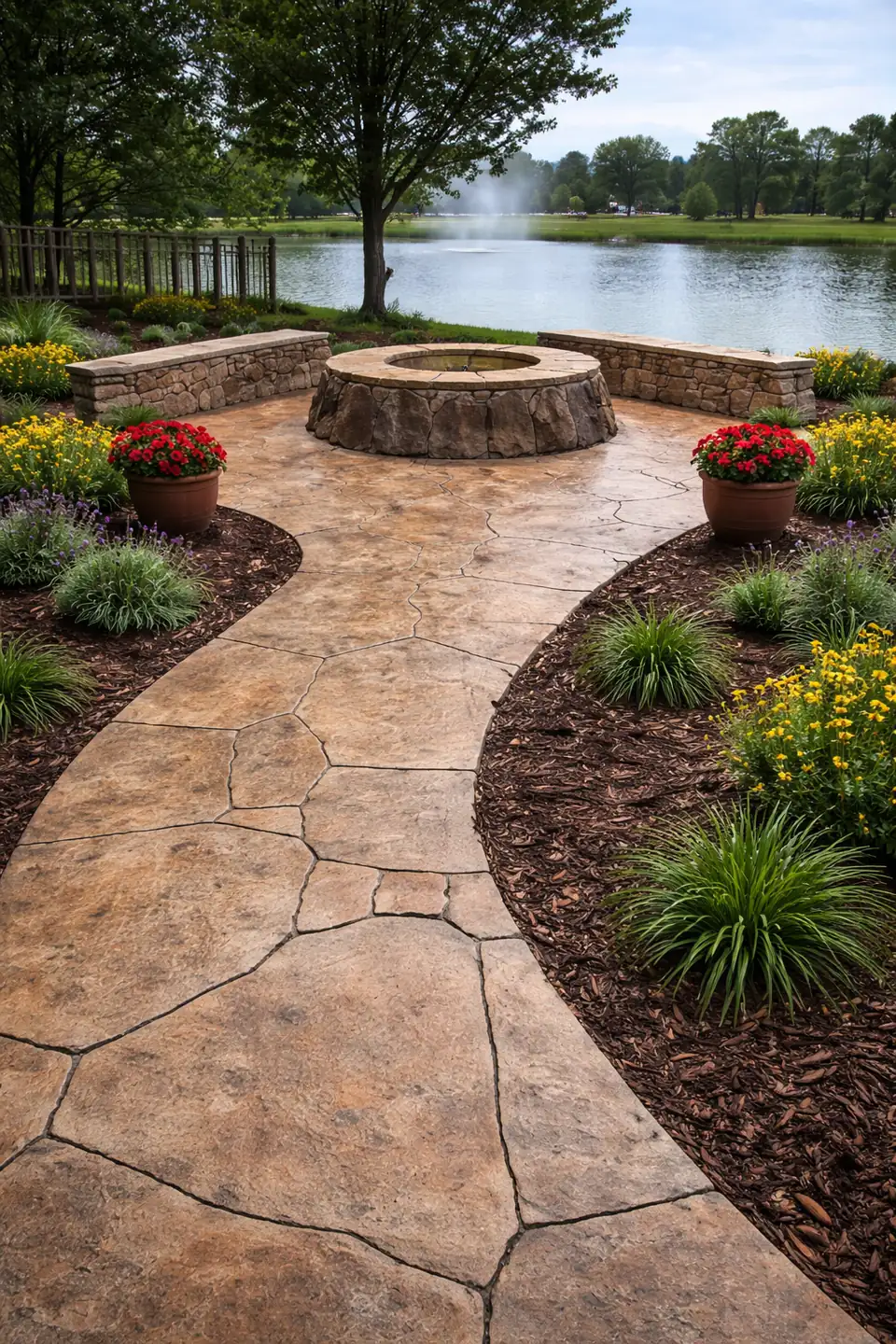
How a Stamped Pour Is Built
Stamping is a timing job. The pattern has to go in while the concrete is still open enough to take an impression but stiff enough to hold one, and that window is short on a hot Texas afternoon. Everything before the pour exists to make that window usable.
Base and Reinforcement
We excavate to depth, bring in aggregate base, and compact it in lifts. Compaction is where most failed slabs were lost, long before anyone mixed concrete. Rebar or welded wire goes in on chairs so the steel sits in the middle third of the slab rather than resting on the dirt where it does nothing.
The Pour Window
Concrete arrives at a slump we control rather than whatever is convenient. Too wet and the pattern closes up behind the mat. Too stiff and the mat rides on the surface without biting. On summer pours we schedule early, run evaporation retarder, and stage enough hands to stamp the whole field before any of it sets up.
Stamping the Mats
Crews walk the mats across the field in sequence, tamping each one to full depth and lifting clean. Alignment is set off a chalked control line, not by eye, because a pattern that drifts two degrees across 30 feet reads as crooked from the back door. Edges and perimeters get hand tools, and touch-up work closes any seam the mats left.
Color in Three Passes
Integral pigment goes in at the plant so color runs through the full slab depth. Release agent is broadcast ahead of the mats, and it both keeps the rubber from sticking and drops a secondary tone into the texture. After cure, antiquing stain is worked into the low points and rinsed back off the high points. The contrast between those three is what makes the surface read as stone instead of colored concrete.
Cure and Seal
The slab cures before anything goes on top of it. We then power wash the residue, let it dry, and roll two thin coats of sealer rather than one thick one. Thin coats bond; thick ones cloud and peel.
Pattern Options We Run
- Seamless stone texture: no repeating joint lines, reads as a continuous carved surface
- Ashlar and random stone: cut-block layouts in mixed sizes for patios and entries
- Running bond and herringbone brick: traditional masonry look for walks and drives
- Cobblestone fans: old-world curves, popular on circular drives and motor courts
- Wood plank: grain and knot detail without the rot, splinters or annual stain
- Geometric tile: Mediterranean and modern layouts for courtyards and entries
- Hand-cut borders: a contrasting band framing the main field
Color Work: Integral, Release and Antiquing
Color is where a stamped patio either looks built or looks ordered from a catalog. Integral pigment sets the base tone and protects you from a chip exposing gray underneath. Release tone sits in the texture and gives the surface variation across the field. Antiquing stain is the final pass and the one with the most judgment in it, because how much you leave in the low points determines whether the surface reads as weathered or as painted.
We keep physical samples on site during selection so you are choosing from cured concrete in daylight rather than from a printed chip. Colors shift under Texas sun, and a tone that looks right in a showroom can read orange at two in the afternoon on a west-facing patio.
Where Stamping Works and Where It Does Not
Stamping works on new pours where we control the base, the mix and the joint layout. Patios, driveways, walkways, entries, courtyards, commercial entrances and outdoor dining areas all fall in that group.
Stamping does not work on an existing slab. The surface has to be plastic to take an impression, so an old driveway cannot be stamped in place. The equivalent for existing concrete is a stamped overlay bonded over the top, which is a separate system covered on our concrete overlays page. We also will not stamp over a slab that is moving, because a pattern does not hold a failing base together.
What Stamped Concrete Costs in Dallas-Fort Worth
Finished stamped work runs $8 to $15 per square foot. Basic stamping starts at $8 and premium patterns start at $12. Pattern complexity, number of color passes, border work and site access drive where a given project lands in that band.
Quarried material installed runs $15 to $30 and up per square foot. On a 500 square foot patio that is a $3,500 to $7,500 difference for a surface most people cannot tell apart from six feet away. The gap widens on larger fields, because stone labor scales with every piece set while stamping scales with crew size on a single pour day.
Timeline is the other cost people forget. A stamped patio is poured, stamped, colored and sealed in 2 to 3 days. Setting individual stone on the same footprint takes 2 to 3 weeks with a crew in your yard the whole time.
Control Joints and North Texas Clay
Blackland clay under most of Dallas, Collin and Ellis counties swells when it rains and shrinks when it does not. That movement reaches any slab sitting on it. We cut control joints on a grid tied to slab thickness, place them at re-entrant corners where cracks want to start, and run them along pattern lines so they disappear into the design.
Isolation joints separate the slab from anything rigid it touches, including house foundations, columns and pool shells. Without them, two structures moving at different rates will crack whichever one is weaker. Joint fillers are color-matched and flexible rather than hard, so they compress instead of splitting.
Heat, UV and Sealer Choice
Surface temperature matters on anything people walk on barefoot. Lighter tones reflect more than dark ones, and a light tan patio will run noticeably cooler than a charcoal one in August. We flag that during color selection rather than after the first hot weekend.
Sealer choice is a real decision, not a formality. Solvent-based acrylics bring out color depth and gloss but need more frequent renewal under direct sun. Water-based systems hold up longer against UV with less shine. For full sun exposures on south and west elevations, we specify UV-stable formulations because a sealer that yellows will take the whole color scheme with it.
Air-entrained mixes handle the freeze-thaw cycles that hit North Texas a handful of nights each winter. It is not the sustained cold that damages concrete here, it is the repeated crossing of freezing with moisture in the surface pores.
Driveways, Approaches and City Permits
A patio in your back yard rarely needs a permit. A driveway usually does, and anything that touches the public approach or the sidewalk crossing almost always does. Requirements differ by jurisdiction, and Dallas, Fort Worth, Plano and Frisco each handle driveway approach work under their own standards for thickness, reinforcement and drainage.
We identify the right office during the site visit and pull what the jurisdiction requires. Homeowners in HOA neighborhoods should also expect architectural review on anything visible from the street, which typically adds a couple of weeks before we can schedule the pour.
Thickness, Mix and Why Driveways Are Different
A patio and a driveway are not the same pour. Foot traffic lets us work at the lower end of the 4 to 6 inch range with welded wire and fiber. A driveway carries vehicle loads, so it gets the upper end of that range, rebar on a grid rather than mesh alone, and thickened edges where the slab meets soil instead of more concrete.
Mix design changes too. Driveways see point loads from tires and the occasional delivery truck, so we use a mix rated up to 4,000 PSI and add fiber for surface crack control. Approach sections that tie into the city gutter often carry their own thickness and reinforcement standard set by the jurisdiction, and those get built to the published detail rather than to the rest of the drive.
Slope is the last piece. Every surface we pour drains away from the house at a fall the code requires, and on stamped work we plan that fall before the pattern layout so water does not sit in the low points of the texture. Standing water in a stamped surface is how sealer fails early and how algae gets a foothold on shaded elevations.
What Pour Day Looks Like
Trucks arrive early, particularly between May and September. Crews place and screed the field, then wait for bleed water to leave before anything touches the surface. That wait is not downtime, it is the difference between a crisp pattern and a smeared one.
Stamping runs as a line, with one crew tamping mats and another following behind on edges and detail. A 500 square foot patio is typically stamped inside a single window. You will hear compactors and see a lot of people moving quickly, because nobody gets to pause once the concrete starts setting.
By the end of day one the pattern is in. Day two is cut joints, wash and antiquing. Day three is sealer. We clean the site and walk the surface with you before the crew leaves.
Maintenance Schedule
Weekly: sweep or blow debris off the surface and rinse with a hose as needed.
As it happens: clean spills before they sit, particularly oil on driveways and anything acidic on patios.
Every 2 to 3 years: power wash and reseal with two thin coats. This is the whole maintenance program, and skipping it is what turns a five-year-old patio into a faded one.
Avoid: de-icing salts, which attack the surface paste, and metal snow shovels, which gouge sealer. Sand gives traction without the chemistry, and a plastic shovel does the same work without the damage.
Service Areas
We pour and stamp decorative concrete throughout the Dallas-Fort Worth metroplex, including:
- Dallas
- Fort Worth
- Plano
- Frisco
- McKinney
- Allen
- Prosper
- Southlake
- Keller
- Grapevine
- Colleyville
- Flower Mound
- Arlington
- Grand Prairie
- Irving
- Carrollton
- Lewisville
- Denton
Contact us today for a free estimate and design consultation.
Related Services
- Concrete Overlays — stamped and textured resurfacing for slabs already in the ground
- Pool Decks — surfaces engineered for wet feet, chlorine and Texas heat
- Hand-Carved Concrete Patios — carved on site rather than stamped from mats
- Outdoor Kitchens with GFRC Countertops
- Outdoor Living Spaces
Featured Projects
See our Stamped Concrete Overlay Patio in Southlake for a before and after on an existing slab.
Learn More
Read our post on Custom Stamped Concrete Patio Designs for Dallas Homes.
Browse our Gallery to see finished stamped work.
Last updated: