Custom Stamped Concrete Patio Designs for Dallas Homes
Custom Stamped Concrete Patio Designs for Dallas Homes
A stamped concrete patio gives a Dallas backyard the look of slate, cobblestone, brick or wood plank on one poured slab. We pour it, texture it with stamping mats while it is still plastic, color it in three passes and seal it. Finished stamped work runs $8 to $15 per square foot on our published pricing. A typical 500 square foot patio goes from pour to seal in 2 to 3 days.
This post walks through the design choices, what happens on pour day, what the price depends on, how Dallas clay and weather affect a slab, and what to ask any contractor before you sign.
Why Dallas Homeowners Choose Stamped Concrete
- Pattern choice. One slab can read as ashlar slate, cobblestone fans, herringbone brick or weathered wood plank.
- One continuous surface. Unit pavers and set stone leave joints where weeds grow, sand washes out and pieces settle unevenly. A stamped slab has no loose units to shift.
- Cost. Stamped work runs $8 to $15 per square foot on our pricing. Quarried material installed runs $15 to $30 and up.
- Color through the slab. Integral color is mixed in the truck, so a chip shows color instead of gray.
- Straightforward upkeep. Sweep, rinse and reseal every 2 to 3 years.
Our stamped concrete service page has the full pattern list and pricing.
Design Options: Patterns, Borders and Color
Patterns
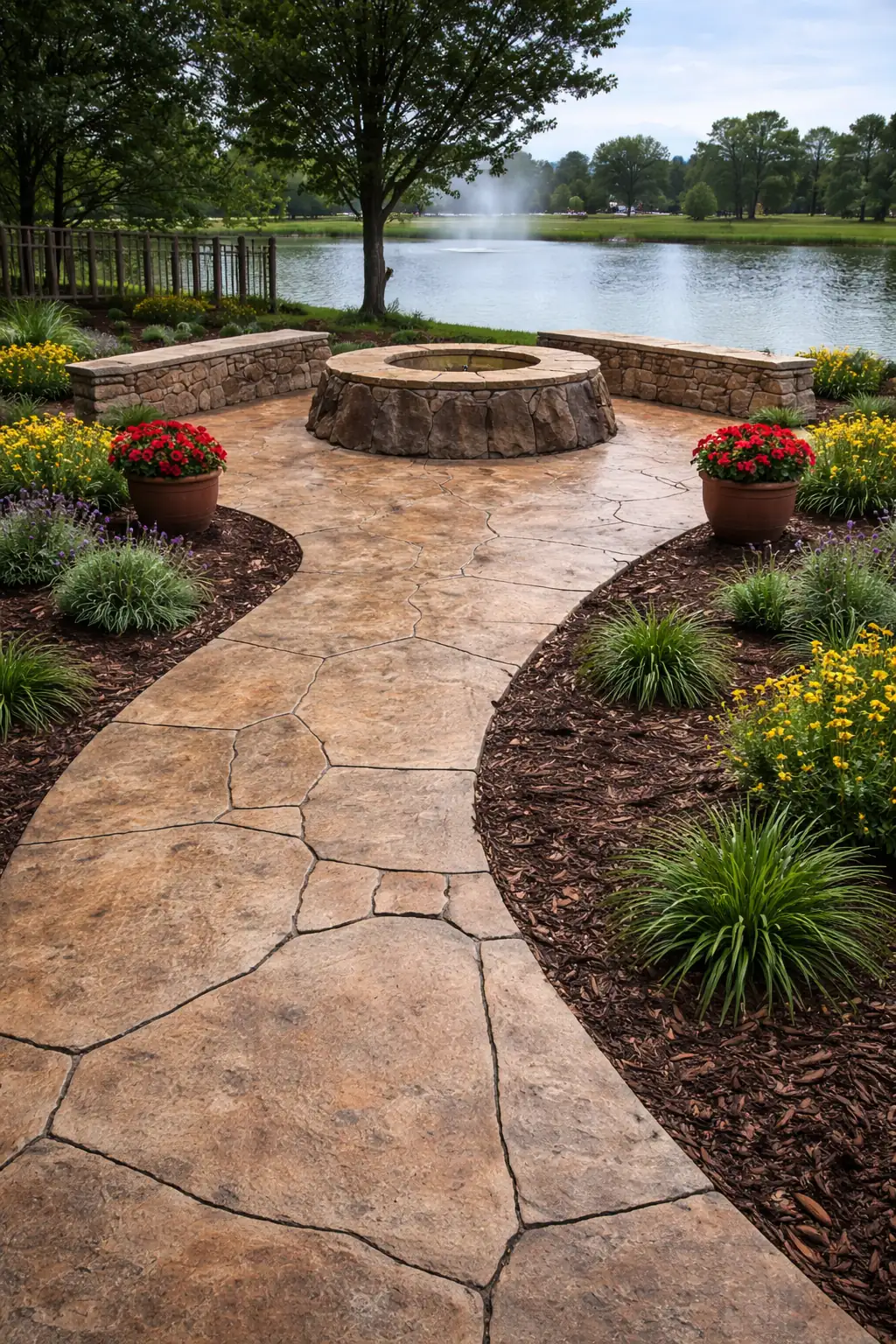
We run seamless stone textures, ashlar and random stone layouts, running bond and herringbone brick, cobblestone fans, wood plank and geometric tile. Pick with the house in mind.
- Ashlar slate suits traditional brick homes and most of the older Dallas housing stock.
- Large-format stone in a charcoal or gray tone pairs with modern builds and flat roofs.
- Wood plank fits farmhouse and Craftsman styles and works well around a pool, where real wood decking would need constant care.
- Cobblestone and fan patterns read European and work best as borders or entry pads rather than a whole backyard.
- Seamless texture gives a stone surface without any joint pattern. It is the quietest choice and the easiest to tie into an existing slab.
Borders
A border frames the main field and hides the seam where the pour meets a walk or the house. Common choices are a contrasting pattern, a smooth troweled band, or a hand-cut soldier course. A border also gives us a clean place to run control joints.
Color in three passes
- Integral color goes into the mix at the plant, so pigment runs through the full depth of the slab.
- Release agent gets broadcast on the surface before the mats go down. It keeps the mats from sticking and leaves a second tone in the low spots.
- Antiquing stain goes on after cure and settles into the texture. That third pass is what gives a stamped slab depth instead of a flat rubber-mat look.
Bring us a photo of a surface you like. We can usually match it with a mat we own or a hand-tooled equivalent.
What Happens on Pour Day
A stamped patio lives or dies on what happens under the surface and during the first few hours after the truck arrives.
Excavation and base. We cut out the sod and topsoil and lay a compacted aggregate base, typically 4 to 6 inches. Dallas sits on expansive clay, and a good base is the buffer between that clay and your slab.
Slope. We pitch the surface at a minimum of 1/4 inch per foot away from the house. Water has to leave the slab and keep going away from your foundation.
Reinforcement. Rebar or welded wire mesh goes in, held up in the slab on chairs rather than lying on the base where it does nothing.
The pour. We pour fiber-reinforced concrete rated up to 4,000 PSI, 4 to 6 inches thick, screed it and float it.
Stamping. Once the surface can hold a texture without slumping, the crew lays the mats in sequence and tamps them in. Too early and the pattern mushes. Too late and the mats will not print. On a hot Dallas afternoon that window closes fast, which is why we start early in summer and size the crew to the pour.
Detailing. Edges, steps and spots the mats cannot reach get hand-tooled so the pattern runs clean to every edge.
Control joints. We cut joints on a grid sized to the slab thickness and line them up with pattern lines where we can, so they read as part of the design.
Wash, stain and seal. After cure we wash off the excess release, apply antiquing, and seal.
How Long Before You Can Use It?
- Foot traffic: 24 to 48 hours once the sealer has set.
- Patio furniture: about a week.
- Vehicles on stamped driveways: 28 days, the standard cure for full design strength.
What Does a Stamped Patio Cost in Dallas?
| Item | Published range |
|---|---|
| Basic stamping, one pattern and color | $8+ per sq ft |
| Premium patterns, borders, multiple colors | $12+ per sq ft |
| Finished stamped work, typical | $8-15 per sq ft |
| Stamped patio, 300-500 sq ft | $5,000-$12,000 |
| Quarried material installed, for comparison | $15-30+ per sq ft |
The bottom of the range is a single pattern in one integral color with a standard release. Multiple patterns, hand-cut borders, extra color passes and detailed antiquing push toward the top. Other factors that move the number:
- Access. A truck that can chute straight into the backyard costs less than a pump truck or wheelbarrows through a side gate.
- Demolition. Tearing out an old slab or a failed paver patio adds haul-off.
- Grade. A yard that falls away from the house needs fill, steps or a small wall to get a level patio.
- Add-ons. Seating walls, fire pits, steps and lighting each add cost and time.
Stamped Concrete vs. Hand-Carved Concrete
We build both, and they are not the same product. Stamped concrete uses rubber mats pressed into fresh concrete. It is fast and costs less, and a good crew hides the repeat well. Hand-carved concrete is tooled freehand, stone by stone, with varied joint widths and textures. Nothing repeats, and it reads closer to real stone up close. It costs more and takes longer. Our hand-carved concrete patio page covers that option, and the Southlake patio and fire pit case study shows a carved flagstone patio in detail.
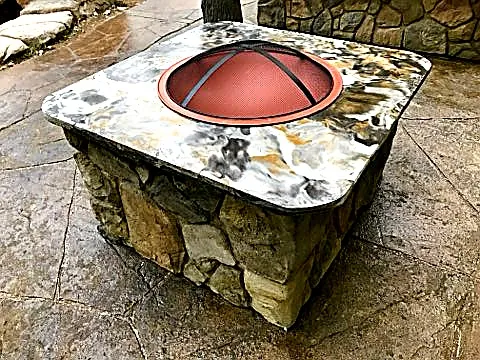
A lot of our Dallas projects mix the two: a stamped field for the big open area and hand-carved detail at the fire pit, steps or seating walls where people look closest.
Stamped Concrete vs. Natural Stone in Dallas
Flagstone and cut stone look great the day they go down. On Dallas clay they tend to rock, settle and heave as the soil moves, and the joints need weeding and re-sanding or re-mortaring. A stamped slab moves as one reinforced piece, and control joints decide where any cracking goes. For the numbers side of the argument, read our concrete vs. stone case study.
Dallas Clay, Heat and Freezes
Clay soil. North Texas blackland clay swells when wet and shrinks when dry. Every slab in Dallas will crack somewhere. The job is choosing where. A compacted base, reinforcement and control joints on a proper grid put cracks in planned lines that hide in the pattern. A slab poured without joints will still crack, just across the middle of your pattern.
Drainage. Water that sits against a slab edge or runs back toward the house feeds the clay under your foundation. Slope the patio away from the house and make sure downspouts do not dump onto it.
Heat. Dark colors get hot underfoot in July. For pool surrounds and barefoot areas, pick lighter tones. Heat also shortens the stamping window, which is why pour timing matters.
Freezes. The National Weather Service in Fort Worth lists the average first freeze at DFW around November 22 and the last around March 12. Freezes here are short but real. Use sand for traction, not de-icing salt. Chloride attacks the surface paste and hazes the color.
Slip Resistance Around Pools and Shade
A stamped texture has thousands of small high and low points that break surface tension, which helps traction. For pool decks and shaded north-facing walks where algae builds up, we add a fine polymer grit to the sealer coat. You will not see it, and bare feet will feel the difference. If the patio wraps a pool, our pool deck service page covers coping and deck options.
Maintenance for a Stamped Patio
- Routine: sweep, rinse, and clean spills before they sit. Grease and leaf tannins stain if left.
- Every 2 to 3 years: power wash and apply two thin coats of sealer. That is what keeps the color the way it looked at handover.
- Winter: sand, not salt. Use a plastic shovel; metal gouges sealer.
- Repairs: faded color comes back with a strip, fresh antiquing and reseal. Chipped edges get a color-matched patch re-textured with the same mat. A crack from base failure underneath is a different job, and we will tell you if stamping over it is a bad idea.
Planning the Rest of the Backyard
Most patios become the floor for something else. Decide early whether you want a fire pit, seating wall, outdoor kitchen or pergola, because gas lines, electrical conduit and footings go in before the pour, not after. Our outdoor living services cover combined builds.
Lighting. Step lights and low-voltage fixtures in a seating wall need conduit run before the concrete goes in. Retrofitting later means cutting the slab or running wire across the top of it.
Shade. A pergola or covered patio needs footings sized for the structure, and those footings have to be placed and inspected before the patio pours around them. If shade is in your five-year plan, tell us now so we leave room for it.
Size. Measure the furniture you own or plan to buy, then add walking room around it. A dining table for six plus chairs pulled out takes more space than most people guess. Building a patio too small is an easy mistake to avoid at the design stage.
Questions to Ask a Dallas Stamped Concrete Contractor
- How thick is the slab and what is the base? You want a specific number for both.
- What reinforcement do you use, and how do you keep it off the ground during the pour?
- Where will the control joints go? Ask to see the layout on the drawing.
- How is the color applied? Integral color should be part of the answer.
- What sealer, and how often will I reseal?
- Who pulls permits and handles the HOA? Patios rarely need a city permit. Driveways and anything touching the city approach usually do. Your HOA may want its own review.
- What is the warranty? Ours is a 5-year workmanship warranty.
Get a Stamped Patio Design for Your Dallas Home
We pour stamped patios across Dallas, Fort Worth and the surrounding cities. Bring photos, a rough sketch or just the idea. We will walk the yard, check grade and drainage, show you pattern and color samples, and put a written price in front of you. Contact us to set up a free on-site consultation.
Last updated: