Carved Concrete vs. Rock Kit Pool Grottos
A carved concrete pool grotto is shaped by hand on your pool. A rock kit bolts together from molded panels, and natural boulders need a crane. In DFW a mid-size carved grotto runs $15,000-$25,000, and a grotto, waterfall and slide combo runs $25,000-$40,000 or more. Kits can cost less up front but show seams and repeat textures.
| Topic | Carved concrete vs. molded rock kit vs. boulder pool grottos in DFW |
|---|---|
| Typical price range | $15,000-$25,000 mid-size grotto, $25,000-$40,000+ for grotto, waterfall and slide combos |
| What it is | Carved rock structure over an existing pool, usually with a waterfall and seating cave |
| Materials | Glass Fiber Reinforced Concrete, hand-carved on site |
| Service area | Dallas-Fort Worth metroplex |
| Works with | Existing pools; we tie into the current pump and plumbing |
| Why GFRC instead of prefab rock | Built to the shape of your pool rather than dropped in from a mold, and no repeating texture |
| Warranty | 5-year workmanship warranty |
Most homeowners who call us about pool grottos have already hit a wall. Their pool builder quoted natural stone, the number came back at $80K-plus, and now they're wondering if there's a realistic way to get the look without gutting their renovation budget. There is — but concrete grottos come with their own set of tradeoffs worth understanding before you commit.
To see how we build carved concrete grottos with a waterfall and slide, and what they cost, go to our pool grotto builders page.
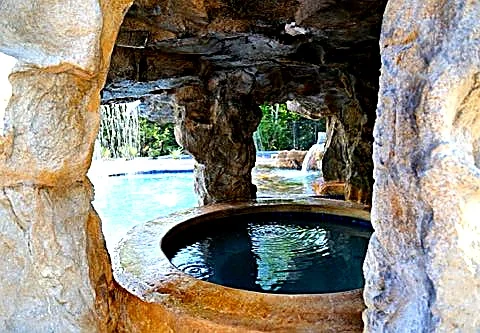
Concrete vs. Natural Stone: An Honest Comparison
Let's get the big question out of the way first. Why would you build a grotto out of concrete instead of actual rock?
Natural stone looks incredible. Nobody's arguing that. But hauling 15-ton limestone boulders into a backyard in Plano creates problems most homeowners don't anticipate. The crane access alone can require removing fence sections, and if your lot backs up to a neighbor's property line — which most DFW subdivisions do — you may need a temporary easement just for delivery. We've seen projects delayed three weeks over crane logistics.
Concrete sidesteps those headaches. It's built on-site in layers over a steel-reinforced framework, then carved and colored by hand to look like natural rock. The finished product weighs less, costs less to install, and gives you more control over the final shape. A carved concrete grotto from us typically runs 40-60% less than a comparable natural stone build, and the gap widens as the design gets more complex.
That said, concrete isn't perfect. The color will fade over time with UV exposure, and North Texas sun is hard on any finish. You'll need to reseal every 3-5 years and potentially re-stain sections after 8-10 years. Natural stone weathers too, but it weathers differently — it develops a patina rather than fading. Some people prefer that. If you want a grotto that looks better with age and you have the budget, natural stone is still a legitimate choice.
For a broader overview of grotto types and configurations, our Pool Grotto guide covers the basics.
How Molded Rock Kits Go Together
Search "pool grotto kit" and you will find companies that ship grottos in sections. The panels are cast in molds from real rock faces, then trucked to your house and bolted or mortared together around a frame. A crew sets them, patches the seams and paints the joints to blend.
Kits have real advantages. The pieces arrive finished, so there is less carving time on site. The price is easier to pin down before anyone visits your yard. For a simple overhang on a standard rectangular pool, a kit can do the job.
The limits show up in three places. The sizes are fixed, so the grotto gets built around what the catalog offers instead of around your pool. The texture repeats, because every panel from the same mold carries the same cracks and ledges. And the seams are where you look first once you know they are there, and where water finds its way in over the years.
Carved Concrete vs. Rock Kits Side by Side
| Hand-carved concrete | Molded rock kit | Natural boulders | |
|---|---|---|---|
| Fit to your pool | Shaped on site to the pool edge | Stock panels, gaps patched | Hard to fit tight to coping |
| Cave you can sit in | Built as one structure | Limited to kit sizes | Rarely practical |
| Texture | Different on every face | Repeats from the mold | Natural |
| Seams | None, one continuous shell | Every panel joint | Gaps between stones |
| Slide and waterfall | Built into the rock | Add-on pieces | Hard to plumb |
| Cost | 40-60% less than natural stone | Often lowest up front | Highest, plus crane work |
When a Kit Is the Better Buy
We carve concrete, so weigh our opinion with that in mind. There are still jobs where a kit makes more sense.
A small accent, not a cave. If you want a rock spillway or a short overhang and nobody will sit inside it, a kit panel can cover that for less.
You want a fixed price before a site visit. Kits are sold off a spec sheet. A carved grotto gets priced after we measure your pool and check access.
Your pool has no room for a structure. Under about 400 square feet of surface, any grotto eats swim space. A kit will not fix that, and neither will carving. See our pool grotto cost and design guide for when to skip a grotto altogether.
For everything else, meaning a real cave, a slide, several falls or a shape that follows your pool, carving wins on fit and on how it looks up close.
How Concrete Grottos Get Built
Once the design and permit are approved, the build takes 7-10 days on site, depending on size and weather. The sequence goes like this.
First, the pool shell has to be ready — or at least the section where the grotto ties in. If you're adding a grotto to an existing pool, that means partial draining and possibly cutting into the bond beam, which is structural work that requires engineering review. Retrofits cost more than new-build integrations. Plan on a 15-25% premium.
The framework goes up next. Steel rebar and mesh get shaped into the rough form of the grotto. This is where the design either works or doesn't — the proportions have to feel right at full scale, and what looked good in a rendering sometimes needs adjustment on-site. We mock up the opening height with temporary framing so homeowners can actually walk through it and confirm sightlines before we start applying concrete.
Shotcrete — a spray-applied concrete mix — gets layered over the framework in multiple passes. Each layer cures before the next goes on. This part is weather-dependent. If we get a string of 100-degree days (which happens every June through September in DFW), we have to adjust cure times and sometimes work early mornings to avoid the worst heat.
Carving happens while the final coat is still workable. Our guys use hand tools to cut texture into the surface — joints, cracks, ledges, the grain patterns you'd see in real limestone or sandstone. This is skilled labor, not something you can template. A good carver makes or breaks the finished look.
Color comes last. We use acid stains and acrylic washes in multiple layers to build up realistic variation. A single flat color looks like painted concrete. Getting it right means 4-6 color passes with drying time between each one. We plan those passes into the schedule so the color is done before the water goes on.
Grotto Styles That Work Well in North Texas
Swim-through cave with waterfall. This is the most requested configuration. A wide opening behind a sheet waterfall, bench seating inside, LED strips along the ceiling. It works on pools with at least 500 square feet and requires a 6-8 foot rise above the water line. A mid-size version runs $15,000-$25,000 depending on size and finish detail.
Multi-level with slide. Families with kids gravitate toward this. The grotto structure doubles as the base for a water slide that launches from the top. Structurally more demanding — the slide support has to be engineered for dynamic loads, not just static weight. Budget $25,000-$40,000 or more for a well-built version. Worth noting: slides add liability considerations to your homeowner's insurance. Call your agent before committing.
Low-profile grotto shelf. For homeowners who want the shaded alcove feel without a towering rock structure, a lower-profile build (4-5 feet above deck) with a shallow overhang works well. It reads more like a natural rock outcropping than a full cave. Less dramatic, but it fits tighter lots and avoids most height-related permitting issues. These fall in the $15,000-$25,000 range.
Grotto with spa integration. The grotto shelters a raised spa that spills over into the main pool. This combination works particularly well because the grotto provides shade for the spa — a real benefit when your hot tub sits in full Texas sun for eight months of the year. Expect $25,000-$40,000 or more for the combined feature.
Keeping It Looking Good Long-Term
Maintenance on a concrete grotto is straightforward but not zero. Here's what's actually involved.
Every spring, inspect the surface for hairline cracks. North Texas clay soil shifts constantly — we're on expansive clay across most of Tarrant and Collin counties — and that movement can stress the connection points between the grotto and pool shell. Small cracks in the decorative surface are cosmetic and easy to patch. Cracks at the structural tie-in need professional assessment.
Pressure wash the exterior once or twice a year. Algae builds up fast on the north-facing surfaces that stay damp and shaded. A 2,000 PSI wash with a wide fan tip handles it without damaging the color coat. Don't use a turbo nozzle — it'll strip the stain.
Reseal every 3-5 years with a penetrating concrete sealer. This protects the color work and reduces water absorption. Skip this step and you'll see fading and surface spalling within a few years. A professional reseal runs $500-$1,200 depending on the grotto's size.
Your pool chemistry doesn't need to change. The concrete is sealed against chlorine exposure, and the waterfall circulation actually helps with water turnover. One thing to watch: if your calcium hardness runs high (common with DFW municipal water), you'll get white calcium deposits on the waterfall face. A mild acid wash once a year keeps that in check.
Where Carved Concrete Earns Its Cost
Carving pays off most on lots that do not suit a kit. On a sloped yard, we can build the grotto into the hillside so it reads as part of the terrain, and the retaining wall behind it doubles as the grotto's back wall. On a freeform pool, we carve the rock to follow the curve instead of squaring it off to fit stock panels.
Retrofits are the other case. Adding a grotto to an older pool can mean cutting into the bond beam, adding rebar connections and re-plastering that section. That work costs the same whatever the rock is made of, and carved concrete lets us tie the new shell into the old pool edge without seams.
Both situations usually need a city permit, and a hillside build may need an engineering stamp. We handle both before the crew arrives.
What This Costs and Whether It's Worth It
A carved concrete pool grotto in DFW runs $15,000-$25,000 for a mid-size build and $25,000-$40,000 or more for large combos with a slide, several falls or a spa. Most of ours go in as a grotto, waterfall and slide combo. Our pool grotto builders page breaks down what moves the price.
Does it add value to your home? Honestly, it depends. Custom pool features rarely return dollar-for-dollar at resale. A well-done grotto on a high-end home in Southlake or Westlake will appeal to the buyer pool in that price range. The same grotto on a $350K home in Mansfield may actually narrow your buyer pool — some people see it as a maintenance liability rather than an asset. Build it because you want to use it, not as an investment play.
If You're Considering a Grotto
We're happy to walk through your specific situation — lot size, existing pool layout, budget, HOA constraints, all of it. Sometimes the answer is "a grotto would work great here." Sometimes it's "you'd be better off with a waterfall wall and a shade structure." We'll tell you either way.
Reach out to schedule a consultation or give us a call. If you want to see more of what's possible with carved concrete around pools, take a look at our posts on waterfalls and stamped concrete patios.
For a broader look at grotto designs and how they fit into different pool configurations, see our Pool Grotto guide. You can also browse our full range of outdoor living services.
Last updated: