Epoxy Flooring Fort Worth TX | Garage Floor Resurfacing
Texas Stone Craft coats garage and workshop floors across Fort Worth in epoxy and polyaspartic. Standard epoxy runs $3-$5 per square foot, decorative flake $5-$7 and polyaspartic $6-$9. Most residential garages finish in one day, large workshops in two. Polyaspartic resists hot tire pickup, which is what truck garages here need.
| Service | Epoxy and polyaspartic coatings for garages, workshops, tool rooms and light commercial service bays |
|---|---|
| Service area | Tanglewood, Westover Hills, River Crest, Ridglea, Monticello, Arlington Heights, Fairmount, Ryan Place, Berkeley, the TCU corridor and Tarrant County |
| Typical price range | $3-$5/sq ft standard epoxy, $5-$7 decorative flake, $6-$9+ polyaspartic, $8-$12 metallic |
| Typical timeline | One day for most residential garages, two for large or multi-bay workshops. Polyaspartic returns to service in 24 hours, epoxy needs 48-72 before vehicles. |
| Materials | Professional-grade epoxy and polyaspartic, semi-flexible polyurea crack filler, oil-tolerant primers where contamination calls for them |
| Slab conditions | Tarrant County shrink-swell clay cracking, pre-1990 slabs poured with no vapor barrier, deep oil contamination and failed retail coatings |
| Prep | Moisture vapor emission testing, industrial degreasing, diamond grinding to profile, crack and spall repair before primer |
| Expected life | 15-20+ years on polyaspartic, 10-15 on epoxy under normal use |
| Warranty | 5-year workmanship warranty |
| Why polyaspartic instead of standard epoxy | Full-size trucks put more heat and contact pressure on the coating. Polyaspartic resists hot tire pickup where epoxy softens and marks. |
Epoxy Flooring Fort Worth: Garage & Workshop Coatings
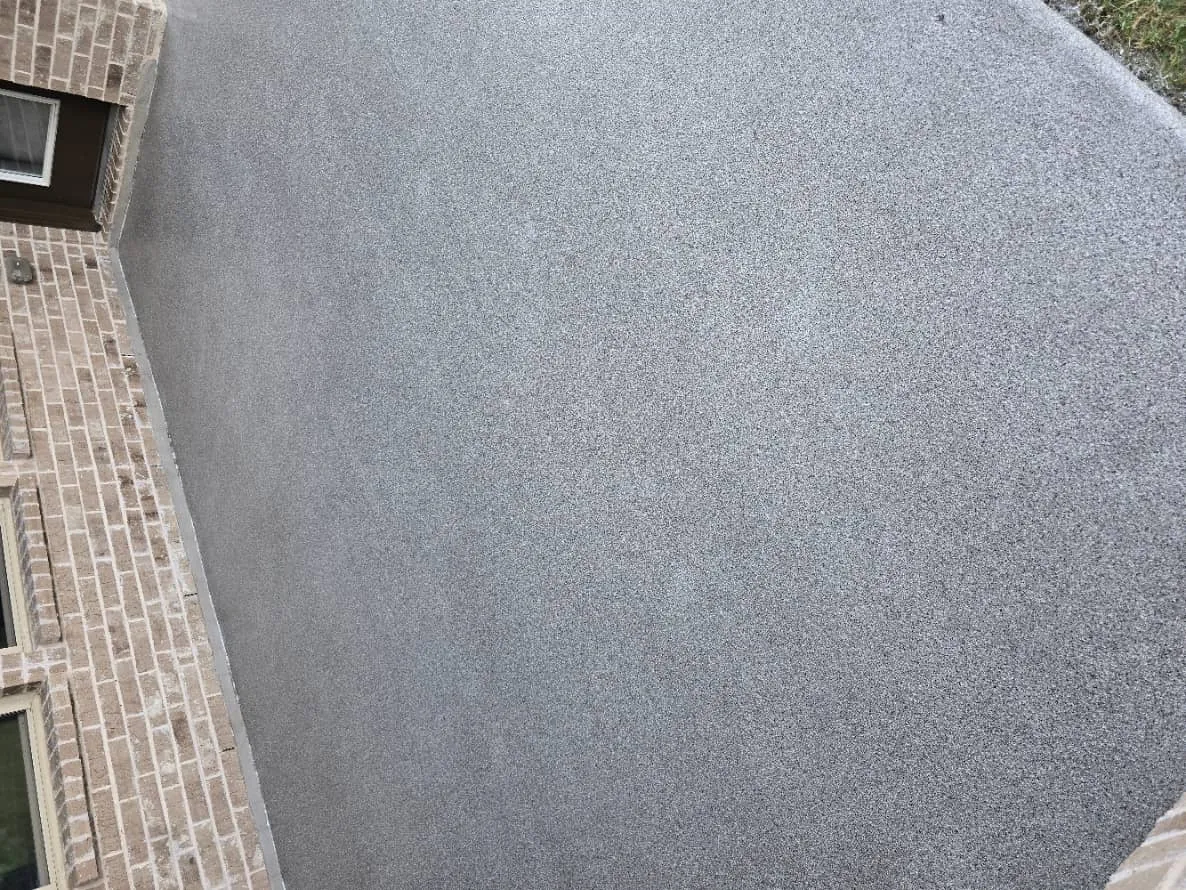
Epoxy flooring in Fort Worth, TX takes more punishment than most cities. Busy family garages with trucks, SUVs, and daily wear. Workshops where tools get dropped, chemicals get spilled, and the floor has to clean up without showing every mark. Utility spaces where the coating has to take abuse and still look reasonable years later. We install both epoxy and polyaspartic floor coating systems in Fort Worth, with the recommendation based on how hard the floor gets used. Garage floor resurfacing comes first on a worn or stained slab: we grind off old sealer and paint and fill the cracks before any coating goes down. An epoxy floor is a two-part resin and hardener coating that bonds to a ground concrete slab and hardens into a seamless, chemical-resistant surface.
Why Fort Worth Garages Need Tougher Floor Coatings
Fort Worth covers a different buyer profile than Dallas or Frisco. This is a market where function comes first. Many Fort Worth garages handle heavier vehicles, more equipment, and harder daily use than a typical suburban garage. That makes the coating system's impact resistance, chemical tolerance, and long-term durability more important than a luxury finish.
The practical consequence is that Fort Worth floors are more likely to have oil stains, surface damage, and prior sealers or paints that need to be removed before coating. Prep work drives the success of every Fort Worth project, and cutting corners on prep is why most DIY and budget coatings fail within the first two years.
Common Fort Worth Garage and Workshop Applications
- Residential garages with trucks and SUVs. Heavier vehicles put more stress on the coating from tire weight, heat, and turning
- Workshops and tool-heavy spaces — tool drops, rolling carts, bench legs, and chemical spills demand impact and stain resistance
- Utility and storage floors — spaces that need to clean up easily without showing every scuff and drag mark
- Mixed residential and small-business spaces — home-based service operations where the floor has to handle both personal and work use
- Light commercial and service bay floors — professional spaces requiring chemical-resistant, easy-clean surfaces
Choosing Between Epoxy and Polyaspartic in Fort Worth
The Fort Worth decision usually comes down to how much abuse the floor will take and what kind of chemicals it needs to resist.
When epoxy makes sense in Fort Worth: Interior spaces with lighter traffic, controlled environments, and limited UV exposure. Budget-focused projects where the slab is in good condition and the homeowner understands the longer cure time and heat limitations. Workshop interiors that do not see direct sunlight.
When polyaspartic is the better call: Any Fort Worth garage with truck traffic, hot tire exposure, or chemical spills. Workshops where the floor needs to come back into service quickly. Spaces with UV exposure near doors and windows. Projects where long-term durability is worth a higher upfront investment because the cost of recoating a failed system later is higher than doing it right the first time.
How We Install Garage Floor Coatings in Fort Worth
Fort Worth slabs get a more aggressive prep protocol than most suburban garages because of the working conditions we encounter here. A typical project runs in eight steps.
- Slab inspection and moisture testing — We check for existing coatings, sealers, oil penetration depth, crack patterns, and moisture vapor. Older Tarrant County slabs built before 1990 often lack vapor barriers, which changes the primer selection entirely.
- Diamond grinding — Industrial planetary grinders open the concrete surface to the correct profile for coating adhesion. This is not a step that can be skipped or abbreviated. Surface profile is everything.
- Oil and contamination treatment — Deep oil stains get industrial degreaser applied and worked in before grinding. If contamination is severe, we use specialty oil-tolerant primers that bond over remediated concrete rather than requiring full removal of affected areas.
- Crack and spall repair — Damaged areas are filled with semi-flexible polyurea filler and leveled flush. Workshop slabs with impact damage from dropped equipment get more extensive repair work than residential garage floors.
- Primer coat — High-penetration primer seals the slab, locks down residual moisture vapor, and creates the adhesion layer for the base coat. The primer selection is matched to the slab condition and system type.
- Base coat application — The primary coating is applied at controlled thickness. Fort Worth workshops get a heavier mil build than light residential use to handle impact and chemical exposure.
- Decorative broadcast — For flake systems, color chips are broadcast into the wet base coat at full or partial coverage. Excess is scraped and vacuumed after the base coat cures.
- Topcoat — A UV-stable, chemical-resistant topcoat seals the system and sets the final sheen. Polyaspartic topcoats return to service in 24 hours. Epoxy topcoats need 48-72 hours before vehicle traffic.
Most Fort Worth residential garages are done in one day. Large workshops or multi-bay layouts may run two days depending on square footage and repair scope.
Garage Floor Resurfacing in Fort Worth
Resurfacing takes a worn slab back to clean, sound concrete so a new coating has something to bond to. Most Fort Worth garages we resurface show peeling hardware-store epoxy, oil soaked into the concrete, or cracks and pitting from years of truck traffic.
We do it in the same visit as the coating. The grinder takes old paint and sealer down to bare concrete. Oil-saturated spots get degreased and ground out. Cracks and spalls get semi-flexible polyurea, which moves with the clay under the slab where a rigid patch would break loose. Primer and coating go down after that, and most two-car garages still finish in one day.
A slab that has heaved or sunk past what crack filler can level needs slab or foundation repair first. We tell you that before we quote, because a coating cannot hide that movement.
Heavy grinding of a failed coating and extensive crack repair are the two prep items that push a Fort Worth job toward the top of the price ranges further down this page.
Fort Worth Workshop and Garage Floor Prep Requirements
Fort Worth workshop floors present prep challenges that residential-only garages usually do not:
- Oil and grease contamination — Deep oil staining from years of vehicle work requires industrial degreasing and aggressive diamond grinding. Surface-level cleaning is not enough for proper coating adhesion.
- Prior sealers and paints — Many Fort Worth shop floors have been sealed, painted, or coated with retail-grade products that need to be fully removed before a professional system can bond properly.
- Impact damage and spalling — Tool drops, heavy equipment, and vehicle jacks create surface damage that must be repaired before the coating goes down.
- Moisture issues — Older Fort Worth slabs, especially those without proper vapor barriers, can trap moisture that causes coating delamination if not tested and addressed during prep.
Fort Worth Slab Conditions That Affect Coating Projects
Fort Worth has some of the most variable concrete slab conditions in the DFW market. Several factors come up repeatedly:
Tarrant County clay soil movement. The shrink-swell clay under most of Fort Worth causes slabs to shift seasonally. Cracks are common, worst at control joints and slab edges. We repair active cracks with semi-flexible filler rather than rigid patching compounds. Rigid filler breaks down when the slab moves again.
Older homes without vapor barriers. Pre-1990 construction in neighborhoods like Arlington Heights, Fairmount, and parts of Ridglea often have slabs poured directly on grade without a moisture membrane underneath. Ground moisture migrates up through the concrete and can cause coating delamination if not accounted for in the primer selection. We test for moisture vapor emission rate (MVER) before specifying any coating system.
Prior retail coating failures. Many Fort Worth garages have one or two layers of hardware store epoxy paint that peeled or bubbled within a few years of application. These failed coatings must be fully removed by grinding before any professional system can bond properly. Trying to coat over failed paint is the fastest way to waste money on a second coating failure.
Workshop concrete with heavy contamination. Garages used for vehicle repair, welding, or fabrication often have oil and solvent contamination that penetrates 1/4 inch or more into the concrete. Surface degreasing alone is not sufficient. The affected layer must be ground away and treated before coating.
Knowing what sits on and inside the slab before quoting is the difference between a coating that lasts 15 years and one that fails in two.
Garage Floor Coating Cost Breakdown for Fort Worth
Pricing for Fort Worth garage and workshop floors is driven by slab condition and system type:
Standard epoxy ($3-$5/sq ft): Functional solid-color coating for garages in decent condition. Good entry point for protected interior spaces where UV and hot tires are not primary concerns. Includes standard surface prep and crack filling.
Decorative flake systems ($5-$7/sq ft): Multi-color flake broadcast that adds texture, hides shop wear, and provides a more finished appearance. The most balanced choice for Fort Worth residential garages that need both durability and decent looks.
Polyaspartic systems ($6-$9+/sq ft): Maximum durability, chemical resistance, and heat tolerance. Best for workshop-grade floors, truck garages, and spaces where the coating needs to perform for 15-20+ years without recoating.
What drives Fort Worth pricing up: heavy oil removal, failed coating grinding, extensive crack and spall repair, moisture mitigation, and oversized or multi-bay workshop layouts.
What is the cheapest way to resurface a garage floor? A one-part epoxy paint kit from a home center costs the least on day one. It also fails first. The paint sits on a slab nobody ground, so it never bonds deep, and hot tires lift it off in patches, the same prep failure described above. A ground slab with a real coating costs more up front and less for every year it lasts, which is the number that matters on a floor you park on daily.
Finish Options for Fort Worth Garages
Fort Worth homeowners and workshop owners tend to favor finishes that prioritize durability and easy maintenance over dramatic aesthetics:
- Decorative flake systems — The most popular Fort Worth choice. Earth-tone and gray flake blends hide dust, shop dirt, and minor scuffing better than solid colors. Full-flake coverage provides light slip resistance and a clean, professional appearance.
- Solid color systems — One flat tone, the cheapest way to seal a shop floor. Shop owners pick these when the slab needs protecting and nothing more.
- Metallic finishes — Less common here than in Dallas or Frisco, though available for a residential garage or flex space that wants a premium look.
UV and Hot Tire Performance for Fort Worth Vehicles
Fort Worth garages often handle heavier vehicles than the Dallas or Plano markets: full-size trucks, SUVs, work vehicles, and trailers. Heavier vehicles create higher tire temperatures and more contact pressure on the coating surface.
Standard epoxy can soften and mark under these conditions, especially in garages with afternoon sun exposure. Polyaspartic coatings resist hot tire pickup even from larger, heavier tires. For Fort Worth truck garages, this is usually the deciding factor in the system recommendation.
Fort Worth Neighborhoods We Serve
Fort Worth project types vary significantly by neighborhood, which reflects the different buyer profiles across the city.
West Fort Worth: Westover Hills, River Crest, Tanglewood. Larger homes with oversized garages. Common projects are three-car garages and collector vehicle storage floors where polyaspartic is the standard recommendation. Homeowners in these neighborhoods typically want a finished appearance alongside heavy-duty performance.
West-Central: Ridglea, Monticello. Active workshop and working garage territory. Ridglea and Monticello garages run a higher rate of oil contamination and failed prior coatings than wealthier zip codes. Prep work on these floors is more involved, and chemical-resistant systems are the default recommendation.
Central Fort Worth: Arlington Heights, Fairmount, Ryan Place, Berkeley. Older housing stock with slabs that frequently show clay movement cracking and moisture issues. These are the neighborhoods where slab testing before quoting matters most. Many projects in this area include slab repair work before the coating goes down.
South Fort Worth and surrounding Tarrant County. TCU corridor, Overton Park, Benbrook-adjacent communities, and areas extending south toward Crowley and Burleson. Mix of residential garages and home-based workshop spaces. We service all of Tarrant County.
Workshop, Home Gym, and Flex Space Coatings in Fort Worth
Fort Worth garage coatings are not limited to vehicle storage. Many Fort Worth homeowners use coated garage space for:
- Workshop and fabrication areas — Impact-resistant coatings handle tool drops, welding sparks, grinding dust, and solvent exposure without degrading the surface.
- Home gym and fitness areas — Durable polyaspartic floors resist rubber mat friction, dropped weights, and heavy foot traffic while cleaning up easily between sessions.
- Flex-use commercial and service spaces — Coated floors in home-based business spaces, small service bays, and storage operations provide a clean, professional appearance that stands up to real daily work.
Featured Fort Worth Projects
Arlington Heights, truck garage upgrade. A two-car garage with daily F-250 use had bare concrete with tire staining and surface pitting. We ground the slab, repaired the damage, and installed a dark-gray polyaspartic flake system built for heavy truck traffic. The homeowner needed the floor back in service fast since the truck could not sit in the driveway for days.
Tanglewood, workshop floor rebuild. A long-time woodworking shop had multiple layers of paint and sealer over damaged concrete. We stripped everything down to clean concrete, repaired the slab, and installed a chemical-resistant epoxy system with a matte finish optimized for shop use. The owner prioritized easy cleanup over glossy aesthetics.
Ridglea, three-car collector garage. A homeowner with two trucks and a weekend project car had a three-bay garage with oil contamination, a section of spalled concrete near the drain, and a prior retail epoxy coat that was actively flaking. We ground everything back to raw concrete, repaired the spalled area with polyurea filler, and installed a full-flake polyaspartic system in a charcoal-and-black blend. The floor handles hot tires from all three vehicles daily. The homeowner needed the system to tolerate brake cleaner and carburetor cleaner without staining, and polyaspartic handles both without degrading.
What Upkeep Looks Like on a Fort Worth Shop Floor
Fort Worth floors carry the same 5-year workmanship warranty we put on every job. Upkeep stays simple. Blow the grinding dust and grit out when it builds up, damp mop with mild detergent, and get after oil and solvent spills the same day they happen. Shop floors benefit from a degreaser pass a couple of times a year.
Polyaspartic systems require no periodic resealing and maintain their finish for 15-20+ years under normal use. Epoxy systems typically last 10-15 years with proper maintenance, though workshop environments with heavy chemical exposure may benefit from an earlier topcoat refresh.
Property Value and Practical ROI
Most Fort Worth homeowners coat the garage for the day-to-day payoff: a cleaner room, less upkeep, and a better place to work. If you sell, buyers on the walkthrough see a finished floor and figure the owner took care of the rest of the house too.
Fort Worth Resources and Next Steps
- Main service hub: Epoxy & Polyaspartic Flooring
- Dallas comparison blog: Polyaspartic vs Epoxy Garage Flooring
- How polyaspartic and epoxy compare in Frisco garages
- Get a quote: Contact Texas Stone Craft
Explore Other DFW Epoxy Service Areas
- Garage Floor Coatings Dallas
- Garage Floor Coatings Plano
- Garage Floor Coatings Frisco
- Garage Floor Coatings Keller
Related Services
Get a written estimate
Tell us about your project and we will set up a time to look at the site and price it. Request an estimate or call (469) 290-1675.
Last updated: