Affordable Faux Stone Concrete Overlays in Fort Worth
Affordable Faux Stone Concrete Overlays in Fort Worth
A faux stone concrete overlay puts a new stone-look surface on a Fort Worth patio, pool deck or walkway without tearing out the old slab. We clean and profile the existing concrete, repair what needs repair, then bond a thin polymer-modified layer over it and stamp or texture it to read as flagstone, slate or wood plank. On our published pricing, basic overlays start around $5 per square foot and stamped overlays around $8. Most patios and pool decks are done in 2 to 3 days.
The catch is the slab underneath. An overlay is only as good as the concrete it sits on. This post covers how to tell whether your slab qualifies, how the work goes, what it costs against replacement, and how an overlay holds up in Fort Worth heat, freezes and clay.
What Is a Faux Stone Concrete Overlay?
An overlay is a cement-based topping with polymers mixed in so it bonds to old concrete and stays flexible enough to go on thin. Depending on the system and the condition of the slab, it runs from 1/4 inch to 3/4 inch thick. Spray-texture systems sit at the thin end. Stamped systems sit at the thick end, because a stone pattern needs depth to hold.
It is a wear surface. It gives an ugly slab a new face. It does not fix a slab that has settled, heaved or lost its base. That distinction decides whether an overlay is a good buy or a waste of money.
Overlay or Replacement? Start With the Slab
We walk every slab before we quote. A slab is a good overlay candidate when:
- It sounds solid. We tap the surface with a hammer. A hollow sound means the old finish or the top of the slab has already let go.
- It sits level within tolerance. No sunken sections, no tipped panels, no trip edges between pieces.
- It drains. Water runs off and away from the house instead of ponding.
- The cracks are small and static. Hairlines and cracks up to about a quarter inch that are not getting wider.
- The moisture condition checks out. Vapor coming up through a slab can push a coating off from underneath.
A slab that fails those checks needs replacement, and we will tell you so. Covering a slab that is still moving hides the problem for a season. Then the crack comes back through along the same line.
If the slab is worn, stained, faded or just plain ugly but otherwise sound, an overlay is the right call.
What an Overlay Costs Compared With Tearing It Out
| Option | Published range |
|---|---|
| Basic overlay | $5+ per sq ft |
| Stamped overlay | $8+ per sq ft |
| Overlay, typical finished range | $5-10 per sq ft |
| Removal and replacement, before decorative finish | $6-12 per sq ft |
On a 500 square foot patio, that works out to roughly $2,500 to $5,000 for an overlay against $6,000 to $10,000 or more for replacement. Replacement also takes 7 to 10 days once you add demolition, disposal and cure time, against 2 to 3 days for an overlay.
Things that move the overlay price:
- Crack repair and patching. More repair means more prep time.
- Pattern and color. A spray texture in one color is the low end. A stamped flagstone pattern with hand-cut grout lines and multiple stain passes is the high end.
- Edges and steps. Vertical faces, step noses and pool coping edges take hand work.
- Access and size. Small jobs carry a higher per-foot cost because setup is the same either way.
For a sense of what a new stamped pour costs instead, see our post on stamped concrete patio designs.
How We Install a Faux Stone Overlay
Day one: prep. We pressure wash and degrease the slab, then mechanically profile the surface so the overlay has something to grab. Old sealers and coatings come off. Static cracks get routed out, filled and bridged. Spalled spots get patched. Then primer goes down.
Day two: overlay and texture. We place the overlay and work it while it is still open. For a stone look, we lay stamping mats, texture the surface, and hand-tool grout lines, edges and steps. Integral or broadcast color and release go on at this stage. We carry existing control joints up through the new surface instead of burying them. That gives any slab movement a planned place to go.
Day three: stain and seal. Antiquing stain settles into the low spots and fracture lines to give the stone depth. Then the sealer goes on.
Weather sets the schedule. In a Fort Worth summer we start early so the overlay is placed before the heat of the afternoon shortens working time. In winter we watch overnight lows, because fresh overlay and sealer both need temperatures above their minimums to cure.
Stone Looks You Can Get With an Overlay
- Flagstone. Irregular stones with hand-cut grout lines. The most requested look for patios and walks.
- Ashlar slate. Rectangular stones in a mixed pattern. Suits traditional brick homes.
- Wood plank. Weathered board texture with grain and nail holes. Popular around pools, where real wood would need constant care.
- Seamless stone texture. Stone surface with no joint pattern. A good way to refresh a slab without a busy look.
- Spray or knockdown texture. A lower-cost finish for pool decks where cool, grippy footing matters more than a stone pattern.
Our Southlake overlay case study shows one real job: an 850 square foot worn stamped patio resurfaced with a 1/4 inch overlay in a hand-carved antique wood grain, finished in three days and tied into the existing pool deck.
Overlay, New Stamped Pour or Hand-Carved Concrete?
We build all three, so we have no reason to push one over the others. The slab and the budget decide.
Overlay. Your slab is sound and you want a new look for the least money and the least disruption. It keeps your existing footprint, slope and drainage. It adds up to 3/4 inch of height, and it cannot change the shape or size of the patio.
New stamped pour. The slab is failing, or you want a bigger or different shape. You pay for demolition and a new base, and you get a new slab poured to current standards. Our stamped concrete service covers that route.
Hand-carved concrete. You want the most convincing stone look, with every stone tooled freehand and no repeating pattern. It costs more and takes longer. It is usually a new pour, though carved detail can also go on steps, seating walls and borders around an overlaid field.
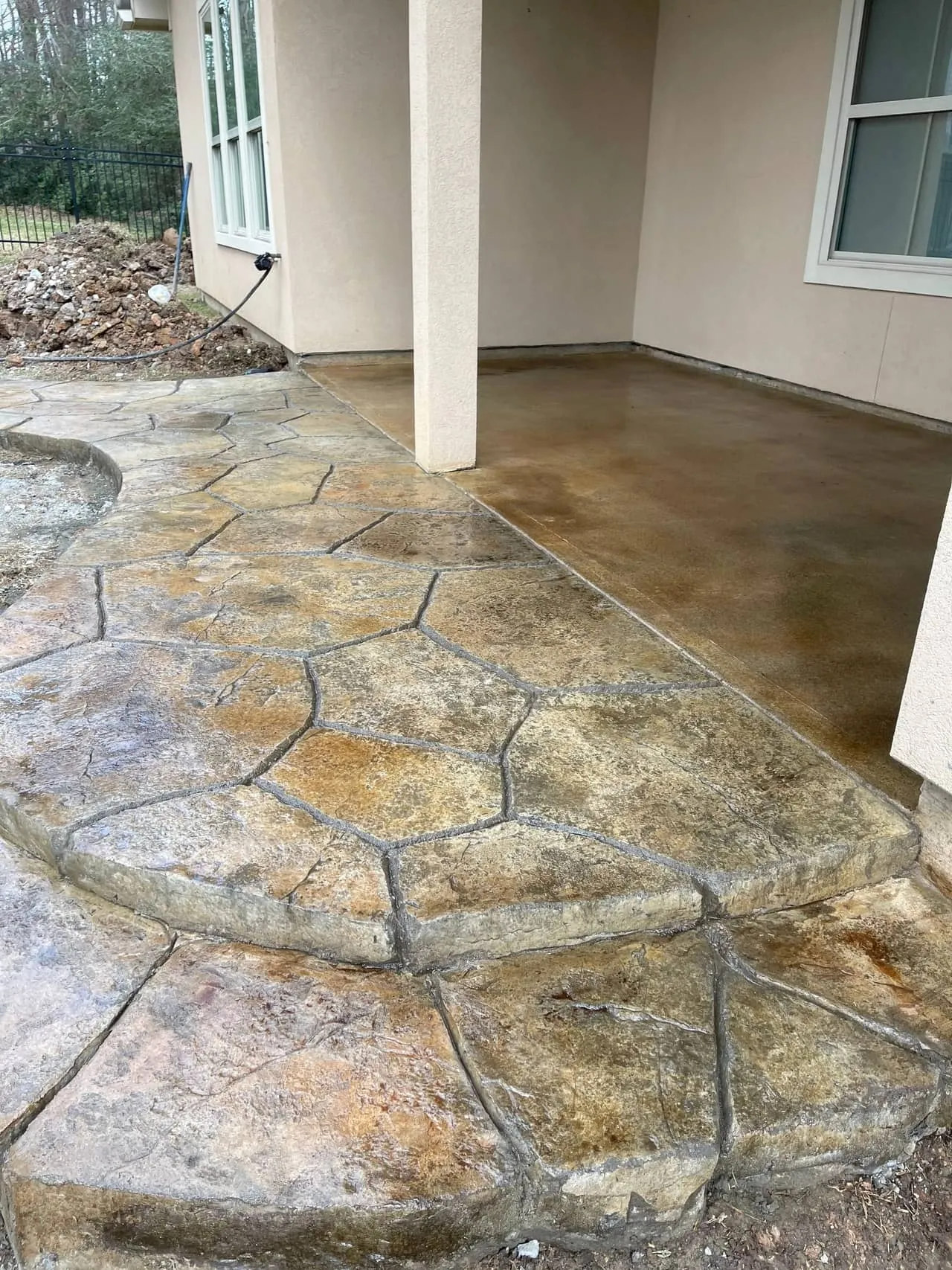
Plenty of Fort Worth jobs combine them: an overlay on a sound back patio, a new stamped pour to extend it, and carved steps tying the two together. The cover photo on this post shows that kind of pairing: a stained slab under the porch and a stamped flagstone-pattern extension stepping off it.
What to Expect During and After the Job
Plan on keeping people and pets off the surface for the days we are working. Move grills, planters and furniture off the slab before we arrive, and keep sprinklers off the area during the job and until the sealer sets. Overspray from a sprinkler head on fresh sealer leaves spots.
After we finish, you can walk on the surface once the sealer has set. We give you the dates for furniture and heavier use before we leave, and we walk the finished surface with you so you know what the color and texture should look like when it is dry versus wet.
Where Overlays Work Best in a Fort Worth Home
- Patios. The most common job. A sound but dated patio gets a new stone face without losing a week to demolition. Our patio page covers new builds if yours needs replacing instead.
- Pool decks. Overlays let us resurface around the pool without cutting into the coping or the pool shell. A textured, light-colored finish helps with traction and heat underfoot. See our pool deck service for more.
- Walkways and entries. A front walk is the first thing a guest crosses. A stone-look overlay upgrades it in a day or two of work.
- Garages and interiors. The thin build means door clearances and thresholds usually still work. Interior jobs use low-odor materials and a different sealer.
How Overlays Hold Up in Fort Worth Weather
Heat and sun. UV fades cheap sealers and cheap color first. We use UV-stable stains and an exterior-rated sealer, and we plan the resealing schedule around full-sun exposure. Lighter colors stay cooler underfoot, which matters on a pool deck in August.
Freezes. The National Weather Service in Fort Worth puts the average first freeze at DFW around November 22 and the average last freeze around March 12. Freeze-thaw damage starts when water gets into the surface. A sound bond and a maintained sealer keep it out. Use sand for traction on ice. De-icing salts attack cement-based surfaces and haze the color.
Clay soil. Fort Worth sits on expansive clay that swells and shrinks with moisture, and some neighborhoods sit on shallow limestone with clay pockets. That movement is why the slab check matters so much. An overlay flexes a little. It cannot bridge a slab that is heaving. If the ground under your patio is still moving, fix the drainage and the slab first.
Drainage. An overlay adds up to 3/4 inch of height. We plan transitions at doors, drains and coping so nothing ends up with a trip lip or a new place for water to pond.
Maintenance and How Long an Overlay Lasts
A properly installed overlay lasts 15 to 20 years or more with periodic resealing.
- Routine: sweep and rinse. Clean up grease, leaf stains and pool chemical spills before they set.
- Resealing: we set the interval at handover based on sun exposure and traffic. When water stops beading, it is time.
- Winter: sand instead of salt, plastic shovels instead of metal.
- Repairs: chipped spots can be patched and re-textured to match.
Our workmanship warranty is 5 years.
Questions to Ask Before You Hire an Overlay Contractor
- How will you test my slab? A contractor who quotes without walking the slab and sounding it for hollow spots is guessing.
- What happens to my cracks? Ask which get repaired and bridged, and what happens to existing control joints.
- What system are you using, and how thick? Stamped overlays need more build than spray textures.
- How do you prep the surface? Pressure washing alone is not enough. Ask about mechanical profiling and primer.
- What sealer, and how often will I reseal?
- What does the transition look like at doors, drains and the pool edge?
- What is the warranty, and what does it cover?
Is an Overlay Right for Your Fort Worth Slab?
If the concrete is sound and you are tired of looking at it, an overlay is the cheapest way to a new stone-look surface. If it has sunk, heaved or broken into moving pieces, spend the money on a new slab and do it once. Either way, the answer starts with a look at the slab.
See our concrete overlay service page for system details, or contact us to set up a free on-site assessment in Fort Worth or anywhere in DFW. More finished work is on our projects page.
Last updated: