Railroad Tie Retaining Walls in DFW: How Long They Last and What Replaces Them
Texas Stone Craft replaces railroad tie retaining walls across DFW. Tie walls fail on no fixed schedule: most ties were worn before they went in, and wet soil rots them faster. They rot from the inside, and our clay swells and shrinks behind them until they lean. We haul off the old ties and quote each wall after a site visit.
| Topic | Railroad tie retaining wall lifespan, failure and replacement |
|---|---|
| Service area | Dallas-Fort Worth, including Arlington, Fort Worth and Dallas |
| Typical railroad tie wall lifespan | Unpredictable: reused ties start partly worn, and runoff or poor drainage shortens it |
| Why they fail in DFW | Wood rots from the inside while expansive clay swells and shrinks behind the wall |
| What we replace them with | Rebar-reinforced concrete hand-carved on site to look like stone or boulders |
| Old tie removal | We tear out and haul off the old ties as part of the job |
| Pricing | Quoted per job after a site visit |
| Warranty | 5-year workmanship warranty |
A lot of DFW yards built in the 1980s and 1990s still have a railroad tie wall holding up a flower bed or a slope along the back fence. Those walls are reaching the end. The ties lean out a little more every summer, the bottom course goes soft, and dirt starts spilling through the gaps.
This post answers the questions homeowners ask us on site: how long the ties last, how to tell yours is done, whether creosote is a problem, and what we build in its place. If you already know the wall has to go, start with our page on railroad tie wall replacement in Arlington.
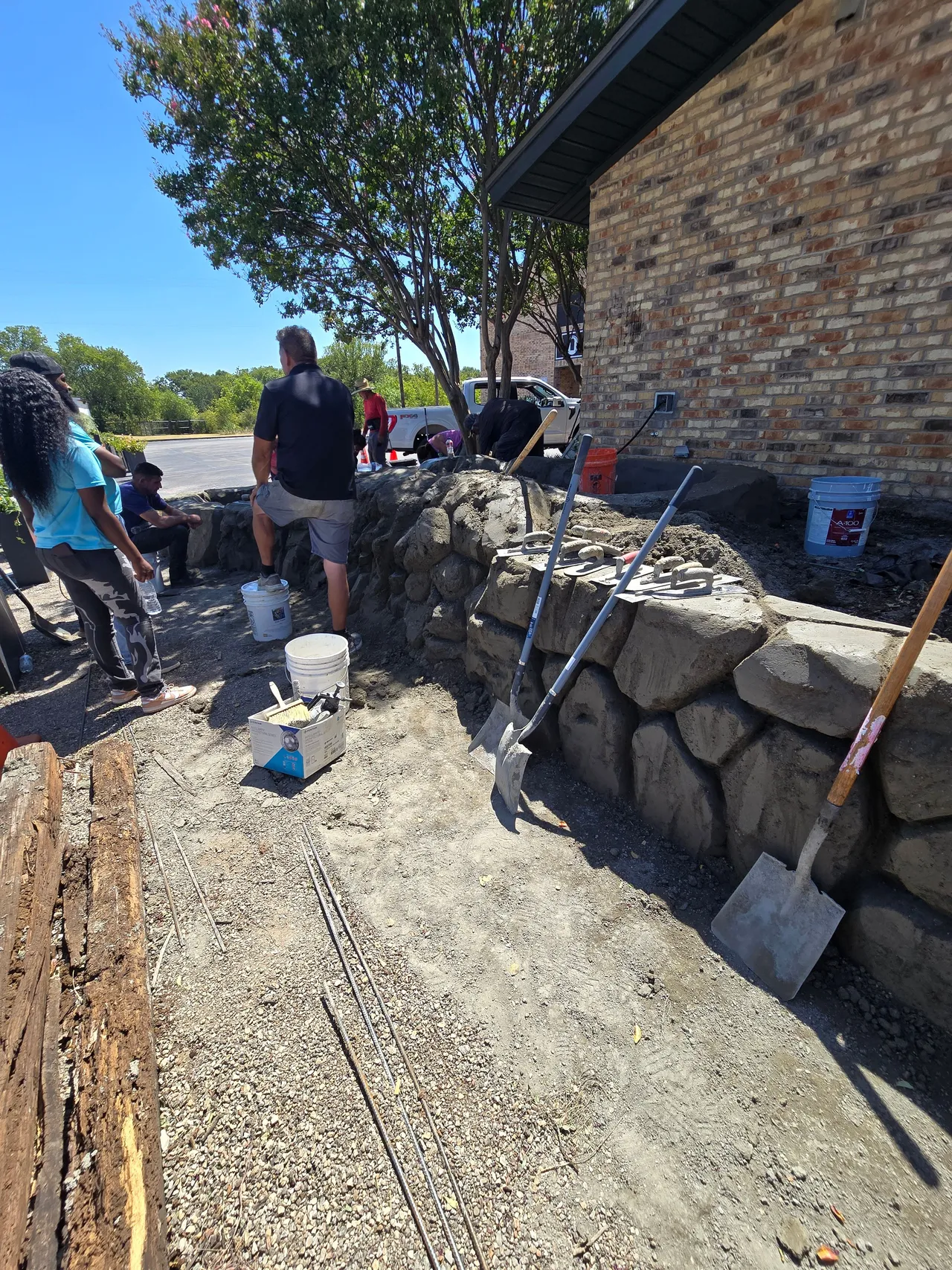
That photo is a Burleson job where we replaced a railroad tie wall. The rotted ties we pulled out lie on the ground at left. The new carved boulder wall goes up beside the brick building on the right.
How Long Do Railroad Tie Retaining Walls Last?
There is no reliable number. One landscaping company that tracks wall lifespans by type lists railroad ties as "unpredictable," because reused ties are often worn out already (Muthler Landscaping). Walls that sit in heavy runoff, or that were built with no drainage behind them, go sooner. If nobody remembers when your wall went in, assume it is near the end.
Three things shorten the clock.
They rot from the inside out. Creosote soaks into the outer layer of a tie. The core dries, cracks and takes on water. A tie can look solid on the face while the middle has turned to pulp. You often find out when you push a screwdriver in and it sinks to the handle.
Most landscape ties were used before they reached your yard. A tie pulled from a rail line already spent years carrying trains and weather. It starts its second life partly worn. A homeowner cannot re-treat it either, because creosote is not sold for residential use.
DFW clay pushes on them. Much of the metroplex sits on expansive clay. It swells when it gets wet and shrinks and cracks when it dries. Every wet-dry cycle shoves the ties forward a little, and nothing pulls them back. Water that soaks the clay behind a tie wall also keeps the wood wet, which speeds the rot. Our post on whether retaining walls need drainage in Texas covers how that pressure builds.
Signs Your Railroad Tie Wall Is Failing
Walk the wall with a screwdriver and a level. Look for these:
- Leaning or bowing. The top course sits out past the bottom course, or the middle of a long run bellies out.
- Soft or crumbling ties. The screwdriver goes in easily, or chunks break off in your hand. Check the bottom course first. It stays wettest.
- Soil washing out at the base. A fan of dirt or mulch on the low side after rain means water is carrying soil through the wall.
- Gaps between ties. Openings that used to be tight now let you see daylight or fill dirt.
- Sinking or uneven top. One end has dropped, or the top line rolls up and down.
- Spikes and deadmen pulling loose. The steel spikes that pin the courses together work out of the wood. Deadmen (the ties that run back into the slope as anchors) lift or rot off.
- Cracks in whatever sits above it. A fence, sidewalk or patio that cracks along the top of the wall means the wall is moving.
One sign by itself on a short garden wall can wait a season. Two or more, or any lean on a wall holding up a driveway, fence or patio, means it is time to plan the replacement.
Do Railroad Ties Make Good Retaining Walls?
They were cheap and easy to stack, which is why so many went in. As a long-term wall they fall short: they rot, they move with the clay, and they carry creosote.
Are railroad tie walls illegal?
No. Owning an existing railroad tie wall is not illegal, and we know of no Texas law that bans one. The concern is the creosote.
The EPA states that creosote "is not approved to treat wood for residential use, including landscaping timbers or garden borders" (EPA creosote page). The Texas Commission on Environmental Quality notes that exposure to creosote may cause cancer in humans, according to both the EPA and the International Agency for Research on Cancer (TCEQ creosote publication GI-285). TCEQ adds that most people are exposed at low levels, and it lists how to keep exposure down.
The practical advice from state agencies:
- Keep creosote ties away from vegetable gardens and children's play areas (New Hampshire DES).
- Avoid using treated wood where people sit on it or touch it with bare skin (TCEQ).
- Wear gloves, long sleeves and eye protection when you handle the ties, and wash up afterward (TCEQ).
- Never burn old ties in a fire pit, fireplace or stove. The EPA and TCEQ both say this.
If your tie wall borders a vegetable bed or a play area, that is one more reason to replace it.
How Tall Can a Railroad Tie Wall Be?
Railroad tie walls work best as short garden walls. Taller ones are where tie walls fail first, because the soil pressure grows with height and the wood and spikes cannot hold it as the ties rot.
Height also brings in the city. In most DFW cities a retaining wall over 4 feet tall needs a building permit, and walls that hold up a driveway, pool deck or structure can need one at any height. Some cities measure from the bottom of the footing, others from grade. Our DFW retaining wall permit guide lists what Dallas, Fort Worth, Plano and Arlington publish. When we replace a tie wall that crosses the permit line, we pull the permit and line up the engineering.
How Much Does It Cost to Replace a Railroad Tie Retaining Wall?
We quote every railroad tie wall replacement after a site visit. Two walls the same length can land far apart once we see the slope, the access and what is behind the ties.
What drives the price:
- Length and height. More face to build means more steel, mix and carving time.
- Access. A side yard a loader fits through costs less than a backyard where everything moves by wheelbarrow.
- Tear-out and disposal. Pulling rotted ties, spikes and deadmen, and hauling them off, is part of the job.
- Drainage. How much water comes off the slope, and where we can send it.
- Soil. Soft or saturated clay at footing depth means more digging.
- What sits above the wall. A driveway, fence or patio adds load and can add engineering.
For published price ranges on the walls we build, see our Arlington retaining wall page.
Should you patch the ties or replace the wall?
Patching buys a few years. You can swap out a rotten tie, add a few spikes, or stake a leaning section. The ties around the patch are the same age and they keep rotting, so the next repair comes sooner.
A carved concrete wall is a one-time build with a 50+ year expected lifespan. It does not rot, and the steel running up from the footing keeps clay pressure from pushing it out of line.
Getting Rid of Old Railroad Ties
We haul off the old ties as part of every replacement job. You do not have to find a place to take them.
If you are pulling a few ties yourself, the rules vary by city and hauler. The EPA says homeowners can usually put creosote-treated wood out with ordinary trash collection, and tells you to check with your state or local waste program first (EPA creosote page). In practice, some haulers and landfills turn ties away or charge extra, and some construction and demolition sites want them cut to length. Call your city's sanitation line or the landfill before you load the truck.
Two rules hold everywhere. Do not burn them (TCEQ says never in open fires, fireplaces or stoves). And do not reuse them for a garden bed.
How We Replace a Railroad Tie Wall
We tear the old wall out and build a reinforced concrete wall that we carve by hand to look like stone or boulders. Texas Stone Craft does not install natural stone. The face you see is carved concrete.
The steps:
- Tear out and haul off. We pull the ties, spikes and deadmen and load them out.
- Dig to solid bearing. We excavate past the loose fill and topsoil to soil that will carry the wall.
- Pour the footing. We set steel rebar in the trench and pour a reinforced concrete footing around it, with vertical bars standing up out of the footing.
- Stack and carve. Our crew stacks a high-strength carving mix onto the steel by hand, one layer at a time. The mix is rated up to 4,000 PSI. While it is still workable, we carve it into boulder or stone texture, so no two sections repeat.
- Drain it. Behind the wall we place gravel backfill wrapped in filter fabric, with a perforated pipe at the base that runs to daylight. Water leaves before it can push.
- Backfill and clean up. We backfill, grade the bed and leave the site clean.
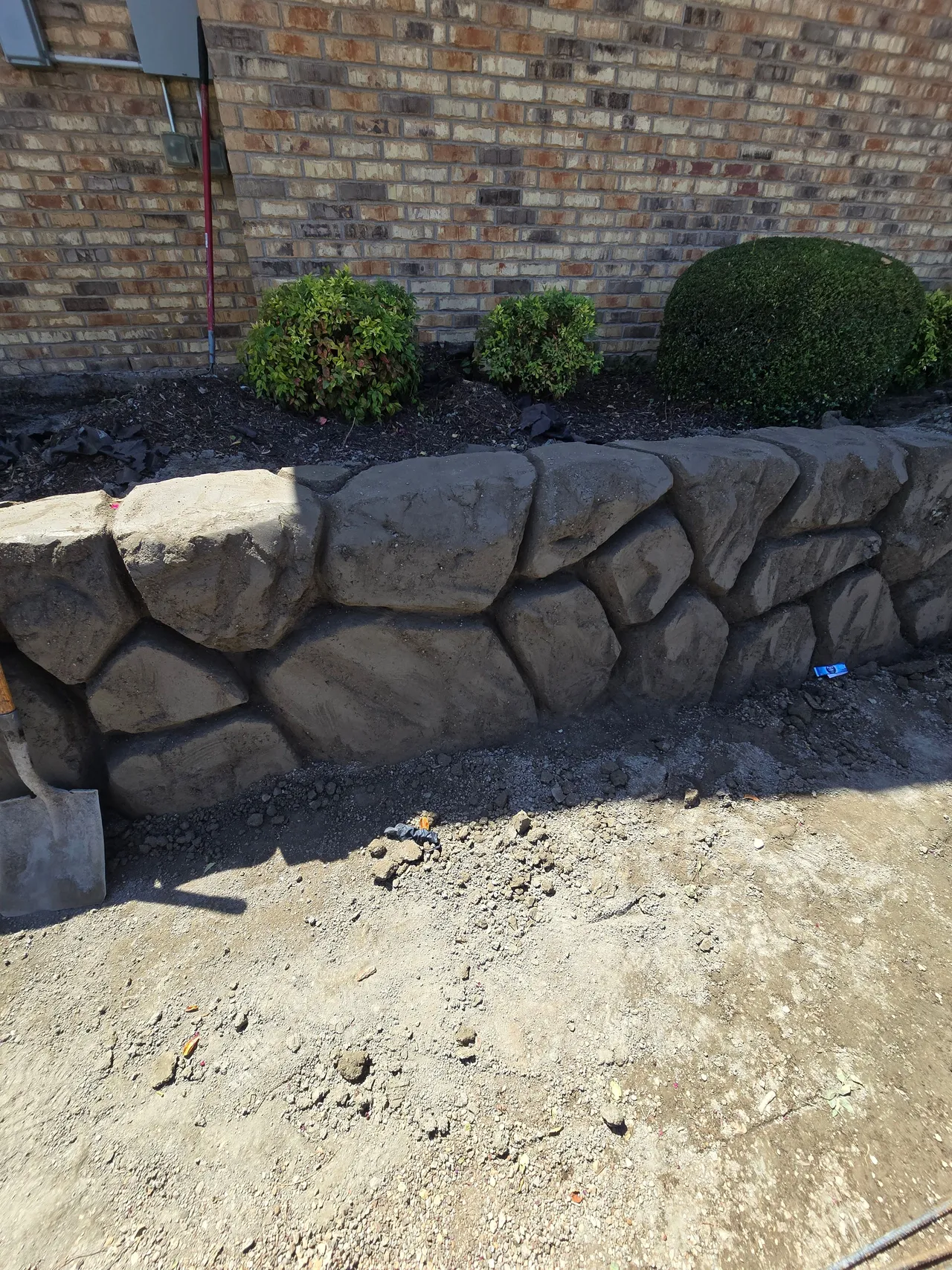
That second photo shows the same Burleson job finished. The carved boulder wall now holds the planting bed and shrubs against the brick building where the railroad ties used to be.
The steel matters most on DFW clay. Ties sit on the ground and rely on their own weight and a few spikes. Our walls tie the face to the footing with rebar, so clay swelling behind the wall pushes against a single reinforced structure.
Every wall we build carries a 5-year workmanship warranty. Reseal the carved face every 3 to 5 years to keep the color and texture sharp.
Quick Answers
Does a 2-foot retaining wall need a footing?
Every wall we build sits on a poured, rebar-reinforced footing, short ones included, because DFW clay moves. A 2-foot wall may not need a permit, but it still needs a solid base below the loose topsoil. Short tie walls laid on bare dirt are the ones we see tipping first.
What is the 1/3 rule for retaining walls?
The most common version says at least one-third of a wall's height should sit below grade. Under that version, a 3-foot wall would have about 1 foot buried (ForeverYard). Other sources use "one-third" for base width instead, saying a gravity wall's base should be about one-third to one-half of its height.
The definitions conflict, and both are rules of thumb for simple gravity walls. Neither replaces the manufacturer's tables for block walls or an engineer's design for a tall or loaded wall. The idea behind both is the same: a wall needs enough of itself in the ground, or under the soil it holds, to keep from tipping. On clay, drainage and steel matter as much as depth.